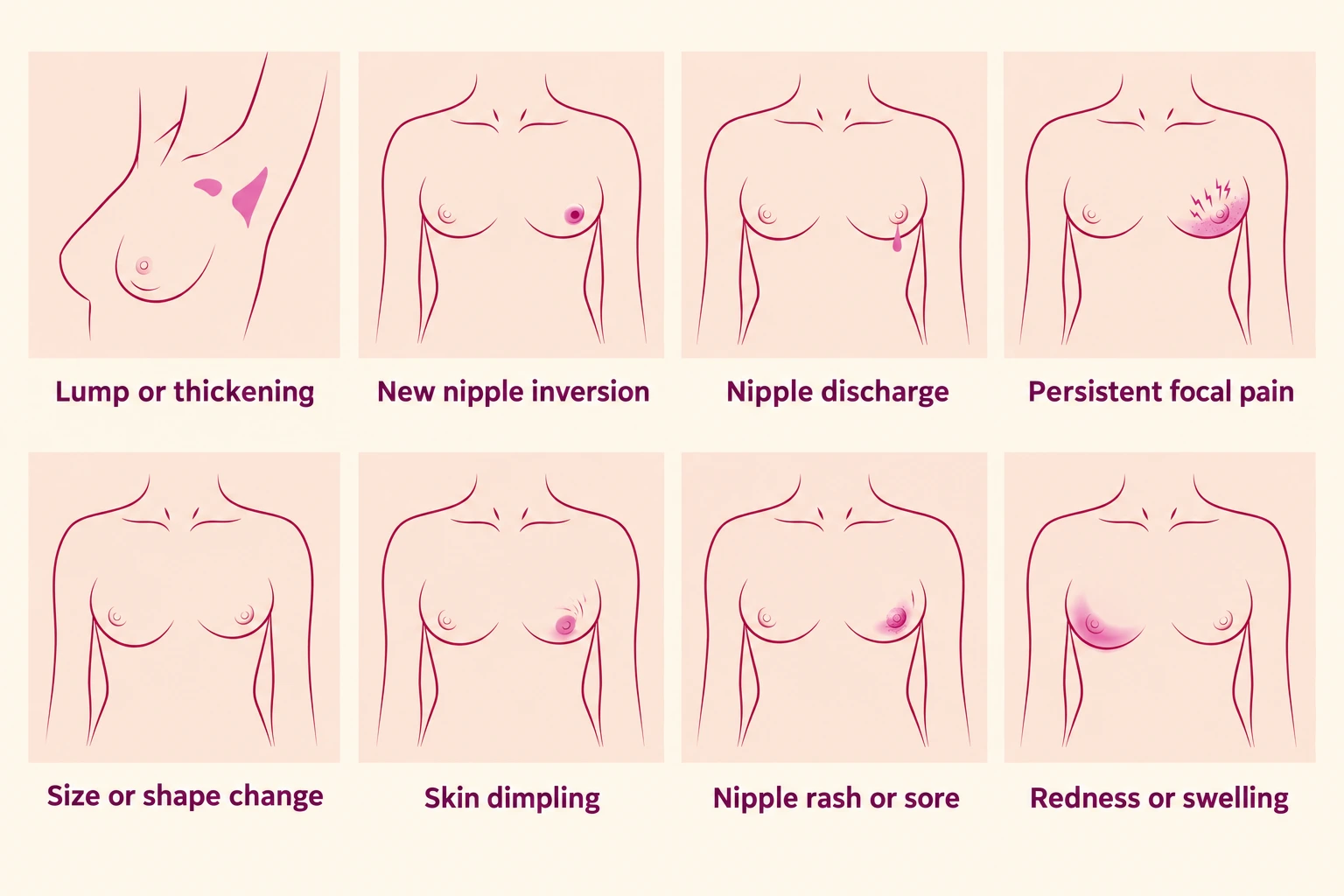
A new lump may be the breast change people recognize most easily, but it is not the only change worth reporting. A nipple that has started turning inward, a patch of dimpled skin, unusual discharge, or swelling can also need medical attention.
Most breast changes are not cancer. Even so, a new or unexplained change deserves an assessment rather than a guess. You do not need to wait for pain, several symptoms, or your next screening mammogram before asking for help.
When should you contact a doctor?
Contact your primary care doctor or OB-GYN promptly for a new lump, thickening, nipple inversion, unusual nipple discharge, skin dimpling, a persistent nipple rash or sore, or an unexplained change in breast size or shape. Describe the change when you book so the office can decide how soon you should be seen. Do not put it off until an annual checkup.
Seek same-day medical advice if your breast becomes hot, red or discolored, swollen, and painful—especially with fever, chills, or feeling unwell. Rapidly increasing swelling or spreading skin changes also need prompt attention, even if you cannot feel a lump. If your usual clinician is unavailable, use an urgent care service.
Get emergency help if a suspected infection is accompanied by severe illness, such as confusion, difficulty breathing, or collapse. In the United States, call 911. These symptoms can indicate a serious systemic illness and should not wait for a routine breast appointment.
Eight breast changes to pay attention to
The drawings show changes to discuss with a healthcare professional. They are a visual guide, not a way to diagnose cancer. A symptom does not have to look exactly like a drawing to deserve assessment.
1. A new lump, thickening, or firm area
Notice a new lump or an area that feels different from the surrounding tissue in the breast, near the breast, or under the arm. A new swelling near the collarbone is also worth mentioning.
Many lumps are caused by noncancerous conditions. However, you cannot reliably decide what a lump is by how it feels. Cancerous lumps are not always hard or painless; they can sometimes be soft, tender, or painful.
Arrange an examination for a new lump even if it does not hurt. Tell the clinician if it seems to be growing or if there are accompanying skin or nipple changes.
2. A nipple that has newly turned inward
Some people have nipples that have always pointed inward. A longstanding, unchanged appearance is different from a nipple that has recently become pulled in, flattened, or started pointing in a different direction.
A new change—particularly on one side—should be assessed. Mention any associated discharge, thickening, or skin changes rather than assuming the nipple change is simply part of aging.
3. Unusual nipple discharge
Milk leakage during pregnancy or breastfeeding can be normal. New discharge outside that context needs a discussion with a clinician.
Be particularly sure to report fluid that comes out on its own without squeezing, comes from only one breast, or is bloody or clear. Discharge accompanied by a lump or a new nipple change also needs prompt evaluation. Color alone cannot tell you whether the cause is serious.
Avoid repeatedly squeezing the nipple to check it, because this can encourage further discharge. Instead, note which side is affected and whether the fluid appears spontaneously.
4. Pain that persists in one area
Breast pain is common, and pain by itself is usually not a sign of breast cancer. Hormonal changes can cause tenderness that follows the menstrual cycle.
Contact a healthcare professional if pain stays in a particular area, does not settle, or occurs independently of your usual cycle. You do not have to wait until pain becomes severe to ask for advice.
Sudden pain is not automatically a cancer symptom. However, pain with a new lump, skin changes, or nipple changes needs assessment, and a hot, swollen breast with fever warrants same-day advice.
5. A change in breast size or shape
Breasts do not have to be perfectly symmetrical. They may also change with the menstrual cycle, pregnancy, breastfeeding, and other hormonal changes.
What matters is a change from your own usual appearance: for example, one breast becoming noticeably larger, a new swelling, or a new distortion of its outline. Report an unexplained change even if there is no distinct lump. A rapid change deserves particularly prompt attention.
6. Skin dimpling, puckering, or an orange-peel texture
Look for a new indentation, a patch of skin that appears pulled inward, or skin that becomes thickened and pitted like the surface of an orange. Clinicians sometimes call the latter peau d'orange.
These changes can have several causes, including inflammation or changes related to scarring, but they need medical assessment. Contact a clinician promptly rather than waiting to see whether a lump develops.
7. A nipple rash, crusting, or a sore that does not heal
Report persistent redness, scaling, crusting, itching, bleeding, or an open sore on the nipple or the darker skin around it, called the areola. A new change affecting only one nipple is particularly important to mention.
Eczema and irritation are possible causes. However, a rare form of breast cancer called Paget disease can also resemble a nipple rash. Do not keep treating an unexplained nipple change with different creams while postponing an examination.
8. Redness, warmth, swelling, or another skin-color change
A breast that becomes warm, swollen, tender, or discolored may be inflamed or infected. This is particularly relevant during breastfeeding, although infection can occur at other times, too.
On darker skin, redness may be less obvious. Pay attention to changes in warmth, swelling, texture, or color compared with your usual skin appearance.
Rarely, rapidly developing swelling and skin changes can be caused by inflammatory breast cancer. It may not produce a lump that you can feel. That is why these symptoms should be assessed rather than dismissed because there is no lump.
If you are treated for a breast infection and symptoms are worsening or have not started improving within 48 hours of antibiotics, contact the treating clinician again. Further assessment may be needed. Do not wait for that interval if you are becoming seriously unwell.
Know your usual appearance without relying on a self-exam
Breast awareness means being familiar with how your breasts usually look and feel. You may notice a change while showering, dressing, or putting on a bra. There is no need to turn everyday awareness into a repeated search for something wrong.
The American Cancer Society does not recommend routine formal breast self-exams as a screening method for people at average risk. Knowing your breasts can help you notice symptoms, but checking them yourself cannot rule out cancer and does not replace recommended mammography.
People of any gender can develop breast problems. A new breast or nipple change in a man also deserves medical assessment. Being young or having no known family history is not a reason to ignore a symptom.
Do not wait for your next screening mammogram
Screening is intended for people who do not have symptoms. A new breast symptom needs a diagnostic assessment, which is a different reason for an appointment.
A recent normal mammogram does not mean a new change can be ignored. Let the office know that you have a symptom when booking, rather than simply requesting a routine screening appointment.
Keep following the screening plan appropriate to your age and risk, even if your breasts look and feel normal. Some cancers cause no noticeable symptoms early on.
What may happen at the appointment?
Your clinician will ask about the change, your medical and family history, medications, and any relationship to periods, pregnancy, or breastfeeding. They may examine the breasts and nearby lymph nodes.
Depending on the findings and your circumstances, the next step may be a diagnostic mammogram, breast ultrasound, or another test. Sometimes a biopsy is needed to establish what an abnormal area is. A referral or a biopsy recommendation does not by itself mean that you have cancer.
Before the appointment, write down when you first noticed the change, whether it affects one or both breasts, whether it is worsening, and whether there is pain, fever, or spontaneous discharge. Ask when to expect results and what to do if the symptom persists.
A change is a reason to check, not a diagnosis
The aim is to notice something new and take the next practical step. You do not need to decide for yourself whether it looks “serious enough” or resembles a particular type of cancer.
If something has changed in your breast or nipple, contact a healthcare professional. Getting it checked can identify a treatable noncancerous problem or help a more serious condition receive timely attention.
Medical sources checked October 24, 2026.
Read the sources
- CDC · Symptoms of breast cancer
- National Cancer Institute · Breast cancer signs and symptoms
- American Cancer Society · Signs and symptoms of breast cancer
- American Cancer Society · Does breast pain mean cancer?
- MedlinePlus · Breast skin and nipple changes
- National Cancer Institute · Paget disease of the breast
- National Cancer Institute · Inflammatory breast cancer
- American College of Radiology / RSNA · Evaluation of nipple discharge
- NHS · Mastitis
- NHS · Breast abscess: symptoms and urgent care
- American Cancer Society · Breast cancer screening recommendations
- National Cancer Institute · Breast cancer screening
- CDC · About sepsis
This article explains selected evidence. It is not a systematic review or individual medical advice.