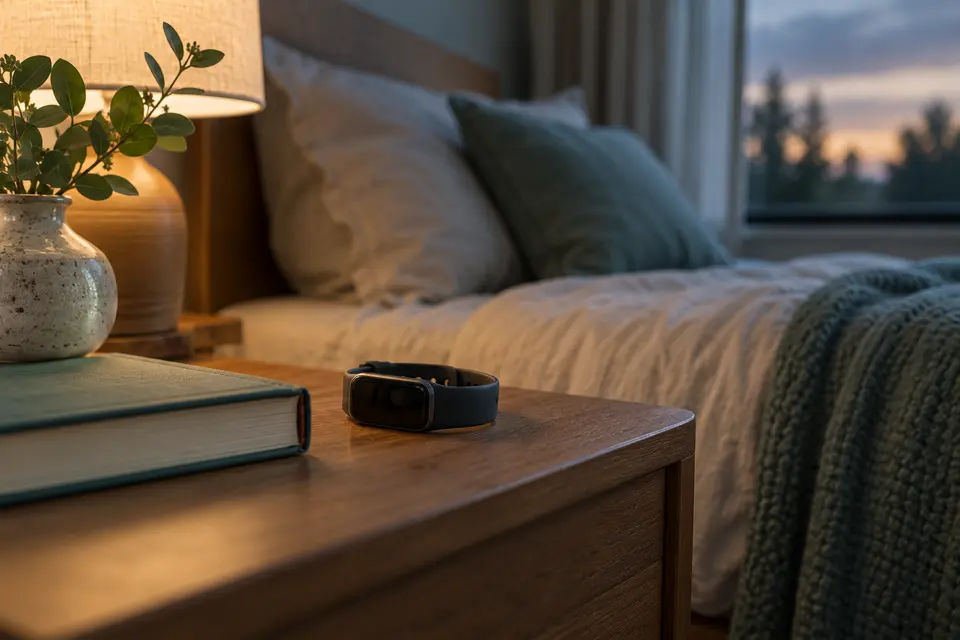
Before trusting a sleep score, ask what the device measures, what its software estimates and whether the specific feature has evidence for the use you have in mind.
You wake up feeling reasonably rested. Your watch gives the night a disappointing score. Which should you believe? Before choosing sides, it helps to ask a different question: what does that score actually represent?
A score is a summary, not an explanation
A product may present several measurements and estimates as a single number. Without understanding how that number is constructed, “better” can mean only “higher according to this product's rules.” It does not automatically explain why you slept differently or what you should change.
The American Academy of Sleep Medicine's 2018 position statement distinguishes consumer tracking from clinical assessment. It calls for rigorous testing and appropriate FDA clearance when technology is intended to diagnose or treat sleep disorders. It also says consumer technology is not a substitute for medical evaluation. This is a dated position statement, not a claim that every feature released since then lacks clearance. [1]
Five questions to ask about a specific device
- What is directly measured? Look for an explanation of the sensors and the difference between recorded signals and software estimates.
- Which model and software were tested? Evidence for another device does not automatically answer your question about this one.
- Who took part? Read the participant description. Ask whether the evidence includes people with circumstances relevant to your intended use.
- What was the comparison? A validation claim should explain what the device was compared with and which result was evaluated.
- What is the feature intended to do? General wellness tracking, a notification and a diagnostic test are different uses. Read the actual intended-use statement rather than inferring it from an advertising headline.
This is our editorial reading checklist. It is not a ranking, an accuracy test or an endorsement of a particular watch or ring.
Separate “interesting” from “actionable”
Before buying, finish this sentence: “I want this device to help me understand…” If your answer is “when my bedtime drifts on work nights,” a record of timing may be relevant. If the answer is “whether I have a sleep disorder,” start with a healthcare professional rather than expecting a consumer score to settle it.
Write down what would count as a useful answer. Otherwise, it is easy to collect more numbers without deciding what question they serve. The same applies to free apps and expensive hardware.
Read your observations with context
Our suggestion is to note the circumstances alongside any score you choose to track: an unusual schedule, travel or a change in routine. This does not prove what caused a result. It simply gives you a clearer record of the question you want to explore.
A paper or digital diary is another way to record your own observations. The NHLBI provides a sleep diary for tracking sleep-related patterns and discussing them with a clinician. [2] You do not need to purchase a wearable to start writing down your bedtime and how you feel.
Before you pay
Check which features require a subscription, whether you can export your records and how the company handles account deletion and data sharing. Those details differ by product and can change; verify them on the manufacturer's current pages. We have not tested products or compared current prices for this article.
If sleep problems persist, discuss them with a qualified health professional. A reassuring score should not end that conversation, and an alarming score should not become a self-diagnosis.
Start with our free habits workbook, or explore the evidence behind caffeine and sleep.
Read the sources
This article explains selected evidence. It is not a systematic review or individual medical advice.