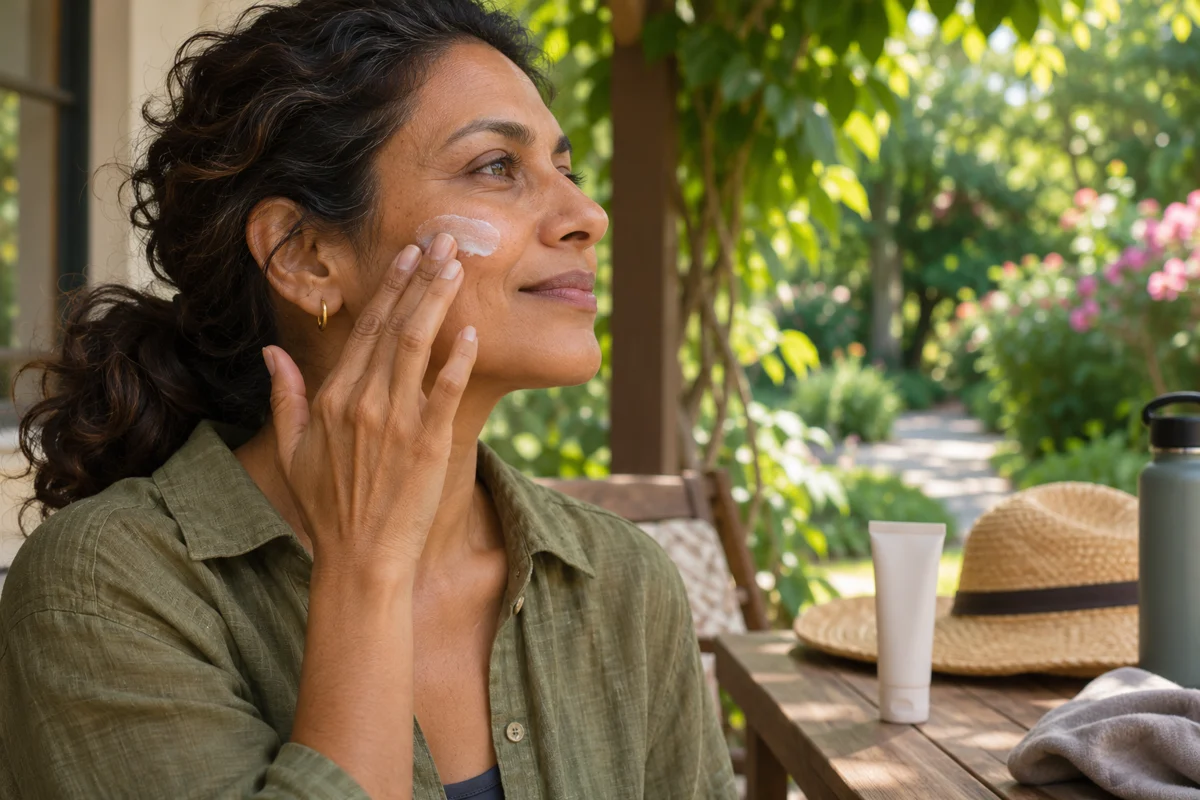
It’s easy to judge a day in the sun by how your skin feels that evening. If it doesn’t sting and there’s no sunburn, you might assume your skin came through just fine. Yet some changes take years to show up: a patch of uneven color on the back of a hand, deeper lines around the eyes, or skin that feels rougher and less elastic than it used to.
Sunscreen has changed, too. The thick white cream you remember from childhood is one option among many. Today there are sheer fluids, gels, tinted lotions and rich moisturizers. What do you actually gain by choosing SPF 50 over SPF 30? Is mineral sunscreen better? And can a cream really slow the appearance of wrinkles?
Why does sunlight age the skin?
Of the different kinds of energy in sunlight, ultraviolet (UV) radiation has the clearest evidence of harm to the skin. The atmosphere blocks the sun’s UVC rays. The two types that matter at ground level are UVA and UVB.
UVB is the main cause of sunburn. It can directly damage the DNA in skin cells. UVA reaches deeper into the skin, where it contributes to changes in collagen and elastin, the structures that give skin its firmness and spring. Both UVA and UVB contribute to skin cancer risk.
Cloud cover doesn’t eliminate UV exposure. Some UVA also passes through ordinary window glass; how much gets through depends on the glass. A long drive with sunlight on one side of your face is a different exposure from a few minutes in a room away from the window.
What happens when skin burns?
A sunburn is an injury. As the skin responds, it can feel hot, tender or swollen; a more severe burn may blister. Redness can be harder to see on darker skin. Skin cells can repair much of the DNA damage, and the body clears away many badly damaged cells. But some changes remain. That is why repeated intense exposure matters even when the soreness has passed.
What does SPF actually tell you?
Sun protection factor (SPF) compares how much UV exposure it takes to cause sunburn on protected skin versus unprotected skin under standardized test conditions. The number mainly reflects protection against UVB. As a rough illustration, properly applied SPF 30 filters about 97% of sunburn-causing UVB; SPF 50 filters about 98%. Neither blocks it all. A thin smear won’t give you the protection measured in the test.
SPF is not a clock. You can receive the same UV dose much faster at midday than early in the morning. Season, latitude, altitude and reflected sunlight all affect the dose.
SPF 30 or SPF 50?
For everyday use, dermatologists recommend a broad-spectrum, water-resistant sunscreen with SPF 30 or higher. SPF 50 or higher is a reasonable choice if you burn easily, have a history of skin cancer or spend extended periods outdoors. Your dermatologist may also suggest it for pigmentation concerns or after certain procedures. The higher number does not buy extra time between applications.
Why look for the words “broad spectrum”?
On a U.S. label, broad spectrum means the product protects against both UVA and UVB. Look for those words alongside the SPF number. You may see a circled UVA symbol on a European product, but the words to look for in a U.S. store are “broad spectrum.” That distinction matters if your aim is to limit cumulative damage as well as prevent a burn.
Mineral and chemical filters: what’s the difference?
Zinc oxide and titanium dioxide are mineral filters. Avobenzone and octocrylene are examples of organic filters, often called chemical filters. Here, “organic” describes their chemistry; it is not a farming or environmental claim.
You may have heard that a mineral sunscreen acts like a mirror. In fact, both kinds of filters protect mainly by absorbing UV radiation. Mineral filters also scatter and reflect some light. A product can contain one type of filter or a combination.
Is mineral sunscreen better?
If other sunscreens sting, a fragrance-free mineral formula is worth trying. The trade-off is that some leave a white cast, particularly on deeper skin tones. A tint that matches your skin can make a difference. Some people prefer the feel of a clear fluid made with organic filters, especially under makeup. Neither category is the best choice for everyone.
What about the safety of chemical sunscreens?
Researchers have detected certain sunscreen ingredients in the bloodstream after application. Detection tells us that an ingredient can be absorbed; it does not, by itself, tell us that the amount absorbed is harmful. The FDA has requested more safety data on a number of ingredients. A request for data is not a finding that a product causes harm.
If you prefer to avoid a particular ingredient, check the active ingredients in the Drug Facts panel. A broad-spectrum mineral product is an option. There is no need to give up sun protection while looking for a formula you like.
Does sunscreen protect against blue light?
It helps to ask where the light comes from. Daylight exposes skin to much more visible light than a typical phone or computer screen. Visible light from the sun can deepen patches of melasma and other pigmentation, especially in darker skin tones.
For someone with melasma, this changes the shopping list: look for a tinted, broad-spectrum sunscreen that contains iron oxides. The pigments add protection against some visible light that an untinted UV sunscreen may let through. There isn’t good evidence that everyone needs a special cream for ordinary screen use.
What about infrared radiation?
Infrared radiation is part of sunlight and is associated with heat. Scientists are studying how it affects skin cells, including processes involved in collagen damage. The evidence for choosing a particular “infrared protection” cream is much less established than the evidence for UV protection.
Some formulas contain antioxidants such as vitamins C and E. Think of these as optional extras. An antioxidant serum has no SPF unless the product itself has been tested and labeled as a sunscreen.
Choosing sunscreen for your skin type
Oily or acne-prone skin
A light fluid, lotion or gel may feel more comfortable. Look for “noncomedogenic,” meaning the formula is designed to be less likely to clog pores. Some products also contain niacinamide. Sunscreen can fit alongside acne treatment, though it does not replace it.
Dry skin
A cream with glycerin, hyaluronic acid or ceramides may be more comfortable than a gel. If a moisturizer offers the broad-spectrum protection you need and you apply enough, it can do both jobs in the morning.
Sensitive skin or rosacea
Pay attention to how your skin feels. If a sunscreen repeatedly burns or stings, try a different formula. A fragrance-free product with zinc oxide or titanium dioxide is a useful starting point. Sunscreen helps protect rosacea-prone skin outdoors, but it is not a treatment for visible blood vessels.
Skin prone to dark spots
For melasma or dark marks left after inflammation, consider a broad-spectrum tinted sunscreen with SPF 30 or higher and iron oxides. Try the shade on your skin: if it looks natural at a full application, you’re less likely to spread it too thin. A new or changing spot deserves an assessment rather than an attempt to fade it yourself.
Can sunscreen delay wrinkles?
Regular use can slow some visible signs of sun damage. In an Australian randomized trial, researchers compared daily sunscreen use with use at the participants’ discretion. After about four and a half years, the daily-use group showed less aging on impressions taken from the backs of their hands.
That finding is more useful than a promise on a jar: it tells us what was measured and over what period. Sunscreen cannot stop the changes that come with age, hormones or genetics. What it can do is reduce the damage added by repeated UV exposure.
How much sunscreen should you use?
SPF is tested using 2 milligrams of product per square centimeter of skin. You don’t need to measure your skin before a walk. A useful guide for an adult in a swimsuit is about 1 fluid ounce (30 mL) for exposed skin. Body size and clothing change how much you need. Apply it evenly to dry skin about 15 minutes before going outside.
Strips of sunscreen along two fingers can be a rough guide for the face, but fingers, tube openings and formulas vary. Make sure you cover the hairline, ears and neck as well. For sandals, remember the tops of your feet; for gardening, the backs of your hands. Use a lip balm with SPF 30 or higher on your lips.
When should you reapply?
Outdoors, reapply at least every two hours. If you swim or sweat, follow the label’s shorter interval: U.S. water-resistance claims specify 40 or 80 minutes of swimming or sweating. Reapply immediately after towel drying. A towel can remove sunscreen even if you were only in the water briefly.
No sunscreen is waterproof. The clearest way to plan a beach day is to pack the bottle with the towels, rather than leave it in the bathroom after the morning application.
Can makeup with SPF take the place of sunscreen?
A broad-spectrum moisturizer or foundation can provide its labeled protection if you use the tested amount. In practice, many people apply foundation sparingly or only to the center of the face. For a day outdoors, it is often easier to apply a dedicated sunscreen evenly, let it settle, then add makeup.
SPF values do not add up. An SPF 15 moisturizer underneath SPF 30 sunscreen does not give SPF 45. Coverage and the amount you apply matter more than the number of layers.
What about winter and cloudy days?
The UV Index is a useful planning tool. The World Health Organization recommends sun protection when the index reaches 3 or higher. For example, a short winter walk at a northern latitude and an afternoon skiing at altitude are very different situations. Snow reflects UV, and you can burn on a cold day.
If you have melasma, a condition that makes you sensitive to sunlight, or skin that is healing after treatment, your clinician may recommend protection even when the index is low.
After a peel, laser treatment or other procedure
Some procedures leave the surface of the skin temporarily more vulnerable to irritation and uneven pigmentation. Ask the treating clinician when it is safe to resume sunscreen. Do not put it on raw or unhealed skin. Until then, follow your wound-care instructions and use shade and protective clothing. Once the surface has healed, your clinician may recommend SPF 50 or higher.
How should you protect children?
For babies younger than 6 months, prioritize shade, a brimmed hat and lightweight clothing that covers the skin. Keep them out of direct sun. If shade and clothing won’t adequately cover an exposed area, ask your pediatrician about using a small amount of sunscreen there.
For older babies and children, choose broad-spectrum, water-resistant SPF 30 or higher. Mineral filters can suit sensitive skin. Remember shoulders and ears, and reapply after swimming or towel drying. A sun shirt is especially handy for a child who keeps running back into the water.
What does “reef safe” mean?
Some UV filters have been detected in waterways, and laboratory studies have found effects on aquatic organisms. The risk in a particular place depends on the ingredient, how much is present and which organisms live there. “Reef safe” or “ocean friendly” on a bottle is not a guarantee of no environmental impact.
A swim shirt lets you cover a large area of skin without applying sunscreen there. Use shade when you can, follow local rules, and protect the skin your clothing leaves exposed.
The most common mistakes
Often the bottle is fine; it’s the way we use it that lets us down. We miss the ears, forget the neck, or wait until the shoulders start to sting before reaching for it. We put a little SPF 50 on in the morning and leave the bottle at home for the rest of the day.
Think about where you will be and what you will be doing. A hat, clothing and a place in the shade all help. Sunscreen covers the gaps; it isn’t a reason to spend longer in intense sun.
Which sunscreen is best?
I like the answer I give patients: the best sunscreen is one you’ll want to wear. Start with broad-spectrum, water-resistant SPF 30 or higher. Then pay attention to what makes you reach for the bottle again tomorrow. Does it feel sticky? Does it leave a cast? Can you put on a generous layer comfortably?
For one person, the answer is a sheer gel. For another, it’s a rich cream that takes the place of a moisturizer. For someone managing melasma, a well-matched tint may matter most. The most expensive product on the shelf doesn’t necessarily do the best job for you.
An investment in your skin’s future
New formulas give us more choice about texture, moisture and tint. The central task hasn’t changed: protect exposed skin from UVA and UVB, use enough product, and renew that protection when it wears off. A bottle you like using, a hat by the door and a little shade on your daily walk can make that routine easier to keep for years.
Read the sources
- American Academy of Dermatology. Sunscreen FAQs.
- American Academy of Dermatology. How to Select a Sunscreen.
- American Academy of Dermatology. How to Apply Sunscreen.
- U.S. Food and Drug Administration. Sunscreen: How to Help Protect Your Skin from the Sun.
- World Health Organization. Ultraviolet Radiation.
- World Health Organization. Radiation: Protecting Against Skin Cancer.
- American Academy of Dermatology. Melasma: Self-Care.
- Zhou, C., et al. (2024). Guide to Tinted Sunscreens in Skin of Color. International Journal of Dermatology.
- Castanedo-Cazares, J. P., et al. (2014). Near-Visible Light and UV Photoprotection in the Treatment of Melasma: A Double-Blind Randomized Trial. Photodermatology, Photoimmunology & Photomedicine.
- American Academy of Dermatology. How Do I Know if I'm Using the Right Sunscreen?
- U.S. Food and Drug Administration. Questions and Answers: FDA's Regulatory Actions on Over-the-Counter Sunscreen.
- Hughes MC, et al. Sunscreen and prevention of skin aging: a randomized trial (2013).
- Cole C, et al. Metal oxide sunscreens protect skin by absorption, not by reflection or scattering (2016).
- National Academies. Review of Fate, Exposure, and Effects of Sunscreens in Aquatic Environments (2022).
This article explains selected evidence. It is not a systematic review or individual medical advice.