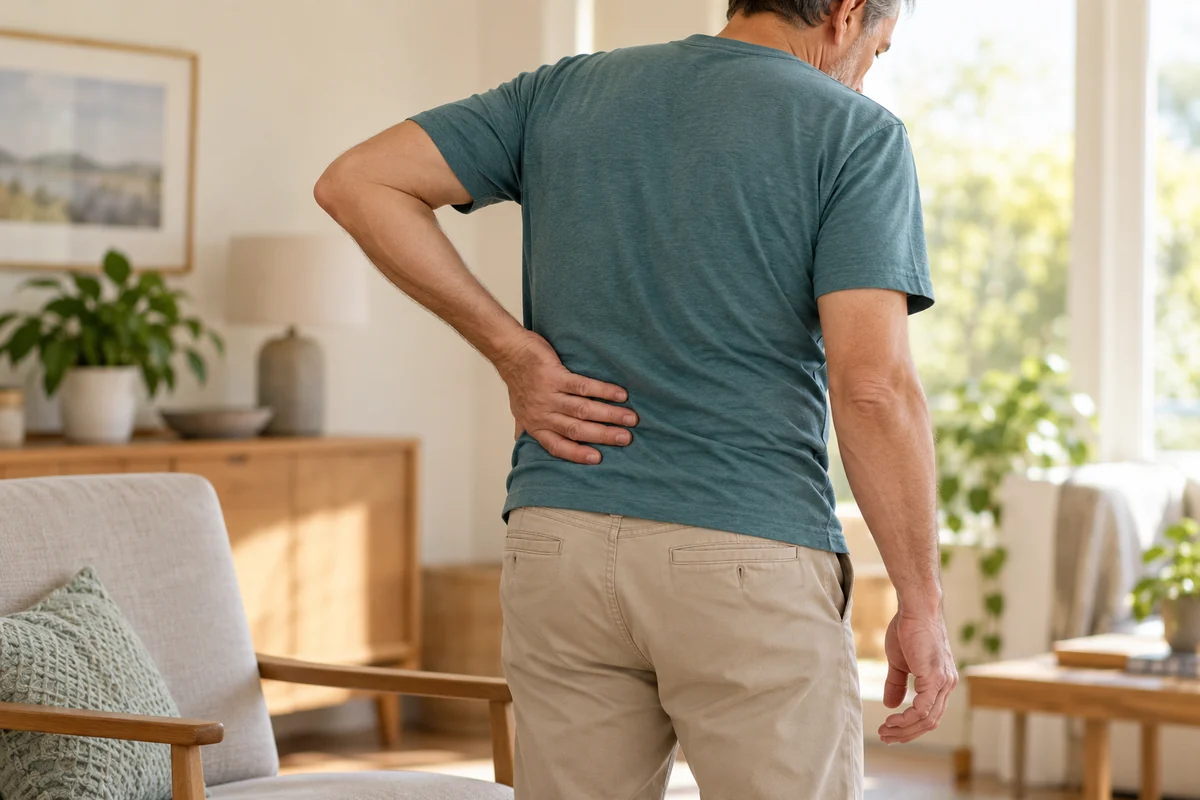
After a night’s sleep, getting out of bed is difficult. Your lower back feels stiff and painful, with sharp pain that gets worse when you cough or sneeze. As you move around, the stiffness gradually eases and the pain becomes more manageable. Should you be concerned, and what should you do?
Back pain can have many causes. Choosing the right approach starts with understanding how it began: was there an injury, an unfamiliar physical task or a long period of sitting? It is just as important to check for symptoms that could indicate a more serious problem.
Do you need imaging right away?
An X-ray or MRI is not always needed as soon as acute back pain starts. A doctor will first ask about your symptoms, examine you and assess the situation.
If pain is mild or moderate and there are no warning signs, the usual advice is to stay gently active, avoid prolonged bed rest and gradually continue everyday movement.
If the cause is unclear, the pain is getting worse or it is not improving, see your primary care doctor. They can assess the next steps and refer you to a specialist if needed. Pain that becomes noticeably worse when you cough or sneeze is also worth discussing with your doctor.
Imaging is chosen according to the suspected cause and whether the result is likely to change treatment.
X-rays help assess bones. They may be needed if a fracture is suspected after an injury or fall, particularly in someone at increased risk of fractures. However, they cannot adequately assess spinal discs, pressure on nerve roots or other soft-tissue changes.
Magnetic resonance imaging, or MRI, provides more detail about discs, nerves and the spinal canal. But it is not necessary for everyone who develops back pain.
Which health professional should you see?
Your primary care doctor is often the starting point. Depending on your symptoms, care may involve an orthopedic specialist, a physical medicine and rehabilitation physician, a neurologist or another specialist.
A physical therapist plays an important role in assessing movement, choosing appropriate exercises and helping you gradually return to activity.
If pain travels into a leg, or you develop tingling, numbness, burning or muscle weakness, a doctor will assess whether a nerve may be involved. You may need to see a neurologist or spine specialist. If your foot suddenly becomes difficult to lift or control, or weakness is increasing, seek urgent medical assessment.
If surgery is being considered, a consultation with a spine surgeon is needed. A pain medicine specialist may also be involved in some cases. Nerve blocks and other invasive procedures are used for specific reasons; they are not necessary for everyone with back pain.
Should you move or stay in bed?
Strict bed rest was once commonly recommended for back pain. Today, prolonged inactivity is generally discouraged: it can increase stiffness and make returning to everyday activities more difficult.
This does not mean exercising through severe pain or immediately returning to heavy physical work. Start with short walks, gentle movements and regular changes of position.
Increase activity gradually, guided by how you feel. If a particular movement makes the pain significantly worse or causes new symptoms in your leg, stop and discuss it with your doctor or physical therapist.
The aim is to gradually regain comfortable movement and confidence in your body.
Your muscles help support your back
The muscles of your back, abdomen, pelvis and buttocks work together to stabilize your body and manage loads as you move. The deep muscles are part of this system.
Prolonged sitting, low physical fitness and demands beyond your current capacity can contribute to discomfort. This may feel like stiffness after sitting, pain when standing up or bending, or an ache after a day at work. These symptoms alone, however, do not identify the exact cause.
Regular, suitable exercise can help improve strength, endurance and movement control. Options include physical therapy exercises, adapted Pilates, strength training and exercises that build capacity for everyday tasks.
No single type of exercise is best for everyone. The important thing is to choose activity that suits your health, abilities and interests—and that you can continue regularly.
Everyday habits that can help
Both your physical fitness and the way you organize your day matter for your back.
When sitting, support your feet on the floor or a footrest. Adjust your chair and desk so your shoulders can relax and working feels comfortable. The top of your screen is usually positioned around eye level.
Even a comfortable workstation does not replace movement. There is no single perfect posture to hold all day. Change your sitting position regularly, stand up and move around.
Before lifting, assess the weight and your own capacity. Keep the object close to your body, move in a controlled way and use your legs and hips. Avoid sudden twisting while holding a heavy load. If something is too heavy, divide the load or ask for help.
Exercise technique depends on the exercise. Some exercises involve gently pressing your lower back toward the floor; others maintain its natural curve. A physical therapist can help you learn the appropriate technique.
When should you see a doctor?
Arrange a medical assessment if your pain:
- does not improve within a few weeks or interferes with daily activities;
- is particularly noticeable at night or does not ease with rest;
- travels into a leg and is accompanied by tingling, numbness or weakness;
- began after an injury;
- develops when you have a history of cancer.
Seek urgent care if the pain is sudden and severe, is getting worse rapidly, or comes with fever and feeling generally unwell. New back pain with a history of cancer also warrants prompt contact with your doctor.
Get emergency medical care immediately if you develop:
- new numbness around the genitals, between the legs or around the anus;
- difficulty starting urination, an inability to empty your bladder, or new loss of bladder or bowel control;
- severe or rapidly worsening leg weakness, particularly in both legs.
Do not wait to see whether an ointment, exercise or rest will help. Go to an emergency department or call emergency services.
Can pain medication help?
Oral medicines or topical products, such as gels, ointments and medicated patches, are sometimes used to relieve pain. The appropriate choice depends on the cause of the pain and your health.
Anti-inflammatory medicines are not suitable for everyone. Other health conditions, medications and potential side effects need to be considered. Ask your doctor or pharmacist if you are unsure.
Follow the product instructions or your doctor’s directions. When an anti-inflammatory medicine is appropriate, use the lowest effective dose for the shortest necessary time. There is no single duration of use that applies to every over-the-counter product.
If pain continues or gets worse, do not simply keep treating it yourself—have the cause assessed.
Heat or cold?
Both cold and heat may provide temporary relief, but the choice depends on the situation.
A cold pack may help after a recent injury with swelling. Gentle heat can ease muscle spasms and stiffness, including in some cases of acute low back pain. It is therefore too categorical to say that new back pain must never be treated with heat.
Do not put a cold or heat source directly on your skin; use a cloth barrier. Avoid excessive temperatures and prolonged exposure that could damage your skin. Stop if symptoms become worse.
How to use a pain-relief gel or ointment
First, read the instructions for the specific product. The amount, frequency and duration of use vary between medicines. Products and approved uses also differ between countries; ask a pharmacist which option is appropriate for you.
Topical pain-relief medicines are generally applied to clean, dry, intact skin. Do not apply them to open wounds, ulcers or mucous membranes. Massage them in only as directed.
Wash your hands afterward, unless your hands are the area being treated and the instructions say otherwise. Avoid getting the product in your eyes.
If your skin is sensitive or you have had allergic reactions before, check the ingredients and ask a pharmacist. Stop using the product if you develop marked redness, a rash or irritation.
Helping your back return to movement
In many cases, back pain improves with time, appropriate movement and a gradual return to activity. Regular exercise and sustainable everyday habits remain useful after the pain has eased.
The key is to recognize the difference between pain that may benefit from gentle movement and symptoms that mean medical care should not wait.
Based on Latvian material by Sergejs Zadorožnijs, traumatologist and orthopedic specialist, supplied by Rimants Pocjus. English translation and editorial clarifications by VitalMeGuide with AI assistance, including clarification of emergency symptoms, heat and cold, exercise technique and medication instructions. This edited English version has not been confirmed as reviewed by the original author.
Read the sources
- NHS · Back pain
- NICE · Low back pain and sciatica in over 16s: assessment and management (NG59)
- ACR / RSNA · Appropriateness criteria: Low Back Pain
- American College of Physicians · Noninvasive Treatments for Acute, Subacute, and Chronic Low Back Pain · 2017
- NHS · How and when to take or use diclofenac (product-specific example; follow local product instructions)
This article explains selected evidence. It is not a systematic review or individual medical advice.