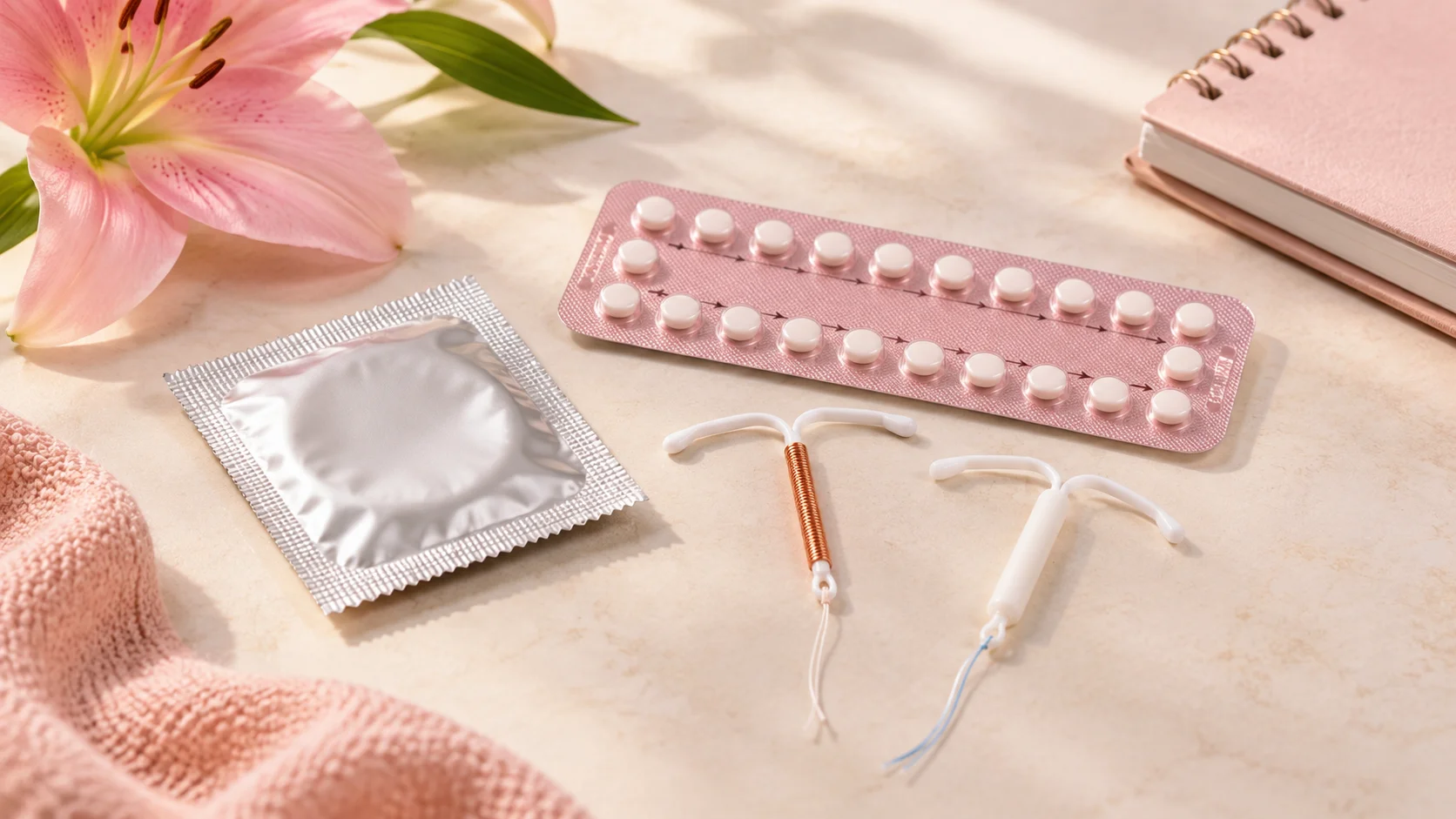
It’s Sunday morning and you notice Saturday’s pill is still in the pack. Do you take it now? Do you need a condom tonight? The answer depends on the pill’s active ingredient and how much time has passed. The same attention to detail helps with other questions, from choosing contraception as a teenager to deciding whether you still need it in your 40s.
If a condom broke or you had sex without effective contraception in the past five days, go straight to question 9. A pharmacist or clinician can help you choose an option today.
1. Can I get pregnant during my period?
Yes. The first day of your period is day one of your cycle. Ovulation can arrive earlier than expected, especially with short or irregular cycles. Sperm can survive for about five days, so sex near the end of a period can lead to pregnancy if an egg is released a few days later. Bleeding alone cannot tell you that it’s a safe day to skip contraception.
Sex during a period is generally fine if both partners want it and feel comfortable. A condom can reduce the chance of pregnancy and of passing a sexually transmitted infection (STI).
2. Does a teenager need to wait until 18 to use birth control?
There’s no medical requirement to wait until 18. A teenager can discuss pills, an implant or an intrauterine device (IUD) with a clinician. An IUD can be an option even if she has never been pregnant. Some teens want relief from painful or heavy periods. Others want a method they won’t have to remember every morning.
A good visit gives the teenager room to say what matters to her and to ask what can be kept confidential. The pill, implant and IUD prevent pregnancy. Adding a condom helps protect against STIs, too.
3. Do I need hormone tests to start the pill?
Most people do not need a hormone panel, pelvic exam or ultrasound just to start birth control pills. Before starting a combined pill, which contains estrogen, you do need a blood pressure measurement. Expect questions about migraine with aura, blood clots, smoking, current medications and recent childbirth. These details can change which options are safe for you.
If you also have unexplained bleeding or very irregular periods, mention it. Your clinician may recommend tests to investigate those symptoms.
4. What’s the difference between a combined pill and a mini-pill?
A combined pill contains estrogen and progestin and usually prevents the release of an egg. It can make bleeding lighter and more predictable. Bleeding during the hormone-free days is a response to the break in hormones.
A progestin-only pill, sometimes called a mini-pill, thickens cervical mucus, making it harder for sperm to pass through. Some formulations also consistently stop ovulation. These pills can be an option for people who need to avoid estrogen, including many who are breastfeeding. Spotting or irregular bleeding is common. Check the active ingredient on the pack because the instructions for a late pill vary.
5. What changes about birth control after 40?
Periods may come months apart during perimenopause, yet you can still ovulate. If avoiding pregnancy matters to you, ask when you can safely stop contraception. Hormonal methods can change your bleeding pattern, which can make it harder to judge menopause by periods alone.
Age is only one part of choosing a method. Estrogen-containing methods should be avoided with migraine with aura. If you smoke and are 35 or older, combined methods are generally discouraged and should not be used if you smoke 15 or more cigarettes a day. High blood pressure and a history of blood clots also warrant a review. A hormonal IUD may be worth discussing if you have heavy periods. A copper IUD is an option if you prefer to avoid hormones, although it can make periods heavier.
6. What should I do if I miss a birth control pill?
Check your pack first. These instructions concern active pills. Missing a placebo does not reduce protection as long as you start the next active pills on time. For a combined pill, count from the time the first missed active pill was due.
- Combined pill, less than 48 hours late: Take the pill as soon as you remember and continue the pack at the usual time, even if that means two pills in one day. Extra protection is generally unnecessary.
- Combined pill, two or more consecutive active pills missed (48 hours or more): Take the most recently missed pill now, discard the earlier missed pills and continue the pack. Use condoms or avoid sex that could result in pregnancy until you have taken active pills for seven consecutive days. If this happened in the last week of active pills, finish the active pills and start a new pack the next day, skipping the hormone-free break. If it happened in the first week and you had unprotected sex in the past five days, seek advice about emergency contraception today.
- Norethindrone or norgestrel mini-pill: If more than three hours late, take a pill as soon as possible and continue on schedule. Use condoms or avoid sex that could result in pregnancy until you have taken the pills correctly for two consecutive days. Ask promptly about emergency contraception if you had unprotected sex.
- Drospirenone-only pill: If just one active pill is late or missed and less than 48 hours have passed since it was due, take it now and continue the pack. If two or more active pills were missed, take the most recently missed one and use condoms or avoid sex that could result in pregnancy until you have taken active pills for seven consecutive days. Follow your pack’s instructions about skipping the hormone-free interval or seeking emergency contraception.
If you’re unsure which instructions apply, take the pack or a photo of its label to a pharmacist. Give the time of the missed doses and of any sex without a condom. Those details matter when choosing emergency contraception because ulipristal interacts with hormonal birth control.
7. Can I get pregnant with an IUD?
It’s possible but uncommon. Fewer than one in 100 IUD users becomes pregnant during the first year. A hormonal IUD thickens cervical mucus and often makes periods lighter. A copper IUD interferes with sperm function and can cause heavier bleeding or cramping, especially in the first few months.
An IUD can occasionally slip out of position or come out. If you think that happened, use condoms or avoid sex that could result in pregnancy until its position is checked. Ask about emergency contraception if you recently had unprotected sex. If you have a positive pregnancy test with an IUD in place, seek prompt medical care to check for an ectopic pregnancy. Severe pelvic pain or fainting needs emergency care.
8. Can an IUD cause infection or infertility?
The overall risk of pelvic inflammatory disease (PID) is low. The small increase in risk around insertion is concentrated in the first 20 days, especially when an untreated cervical infection is present. Untreated infections such as chlamydia can damage the fallopian tubes. Using an IUD itself has not been shown to impair future fertility.
If you’re due for chlamydia or gonorrhea screening and have no known active infection, the sample can usually be collected at the insertion visit. A known untreated infection or signs of an active cervical infection need attention before insertion. An IUD offers no STI protection.
9. How soon do I need emergency contraception, and can I use it again?
Act as soon as possible. In the U.S., levonorgestrel pills such as Plan B One-Step are available over the counter. They work best within three days and become less effective with time. Ulipristal acetate (ella) is prescription-only and can be taken within five days. It tends to be more effective than levonorgestrel on days three through five. A copper IUD placed by a clinician within five days of unprotected sex is highly effective and can stay in place for ongoing contraception. Body weight can affect the effectiveness of oral options, particularly levonorgestrel. A pharmacist or clinic can help you weigh your choices without losing time.
Emergency pills delay ovulation. They cannot end an established pregnancy or protect you during sex later in the cycle. After levonorgestrel, you can start or resume hormonal birth control immediately. Use condoms or avoid sex that could result in pregnancy for seven days. Levonorgestrel emergency contraception can be used again after another episode of unprotected sex in the same cycle.
After ella, wait at least five days before starting or resuming hormonal contraception. Use condoms or avoid sex that could result in pregnancy during the wait and follow ella’s U.S. labeling to use a barrier until your next period. The U.S. label advises against repeating ella in the same cycle because repeat dosing has not been adequately studied. If you need emergency contraception again, contact a pharmacist or clinic promptly for advice rather than combining different pills yourself. If you have no period or withdrawal bleeding within three weeks after emergency contraception, take a pregnancy test.
What about STI protection?
Use a new condom from the start of each sex act. With latex condoms, choose water- or silicone-based lubricant. Condoms lower the risk of many STIs, though infections such as herpes or HPV can spread through skin that the condom does not cover. Barriers can also reduce exposure during oral sex.
Many STIs cause no symptoms. U.S. guidance recommends yearly chlamydia and gonorrhea screening for sexually active women younger than 25, and for those 25 or older who have risk factors such as a new partner. If you may have been exposed to HIV, seek urgent advice about post-exposure prophylaxis (PEP). It needs to start as soon as possible and within 72 hours.
Adapted for U.S. readers by VitalMeGuide from material by gynecologist Dr. Inta Dinsberga.
Read the sources
- Centers for Disease Control and Prevention (CDC). (2024). U.S. Selected Practice Recommendations for Contraceptive Use, 2024. Morbidity and Mortality Weekly Report, 73(3), 1–77.
- Centers for Disease Control and Prevention (CDC). (2024). U.S. Medical Eligibility Criteria for Contraceptive Use, 2024.
- CDC. Combined Hormonal Contraceptives: Clinical Guidance.
- CDC. Progestin-Only Pills: Clinical Guidance.
- CDC. Intrauterine Contraception: Clinical Guidance.
- CDC. Emergency Contraception: Clinical Guidance.
- American College of Obstetricians and Gynecologists (ACOG). Emergency Contraception: Frequently Asked Questions.
- American College of Obstetricians and Gynecologists (ACOG). Long-Acting Reversible Contraception: Implants and Intrauterine Devices.
- CDC. Sexually Transmitted Infections: Screening Recommendations.
- CDC. Sexually Transmitted Infections Treatment Guidelines.
- CDC. HIV Prevention: Post-Exposure Prophylaxis (PEP).
- CDC. HPV Vaccination Recommendations.
- National Health Service (NHS). Periods and Fertility in the Menstrual Cycle.
- DailyMed. Ella (ulipristal acetate) U.S. prescribing information.
This article explains selected evidence. It is not a systematic review or individual medical advice.