The first thing you give up might be driving after sunset. Headlights scatter across the windshield, even when the glass is clean. At home, you move the reading lamp closer. If those changes sound familiar, tell your eye doctor about them. They can say more about how a cataract affects your life than the smallest row of letters you can read in a brightly lit exam room.
When do clearer glasses stop helping?
A cataract is a cloudy area in the natural lens inside your eye. As that lens changes, light scatters on its way to the retina. Print can look blurry, colors can take on a yellow tint, and oncoming headlights can seem painfully bright. A new prescription or a stronger lamp may help for a while. Neither can clear the lens itself.
An eye exam can establish how much of the change comes from the cataract. Glaucoma, macular degeneration or damage to the retina from diabetes can also limit vision, and those conditions may still affect what you see after surgery. If you’re comfortable doing the things you enjoy, you and your ophthalmologist may decide to monitor the cataract. If you’ve stopped driving, reading or working because of it, bring that up at your next visit.
What happens on the day of surgery?
Cataract surgery usually takes place in an outpatient center. Your eye is numbed, and you can tell the team if you feel uncomfortable. You may notice light or movement. Through a small incision, the surgeon usually uses ultrasound to break up the cloudy lens, removes the pieces and places a clear artificial lens inside the thin capsule that held your natural lens. Arrange for someone to take you home that day.
As vision clears, some people notice that a white shirt looks white again or that blue flowers seem brighter. Others improve more gradually. Your result depends partly on the health of the retina and optic nerve and partly on the lens prescription chosen before the operation.
Which lens fits the way you use your eyes?
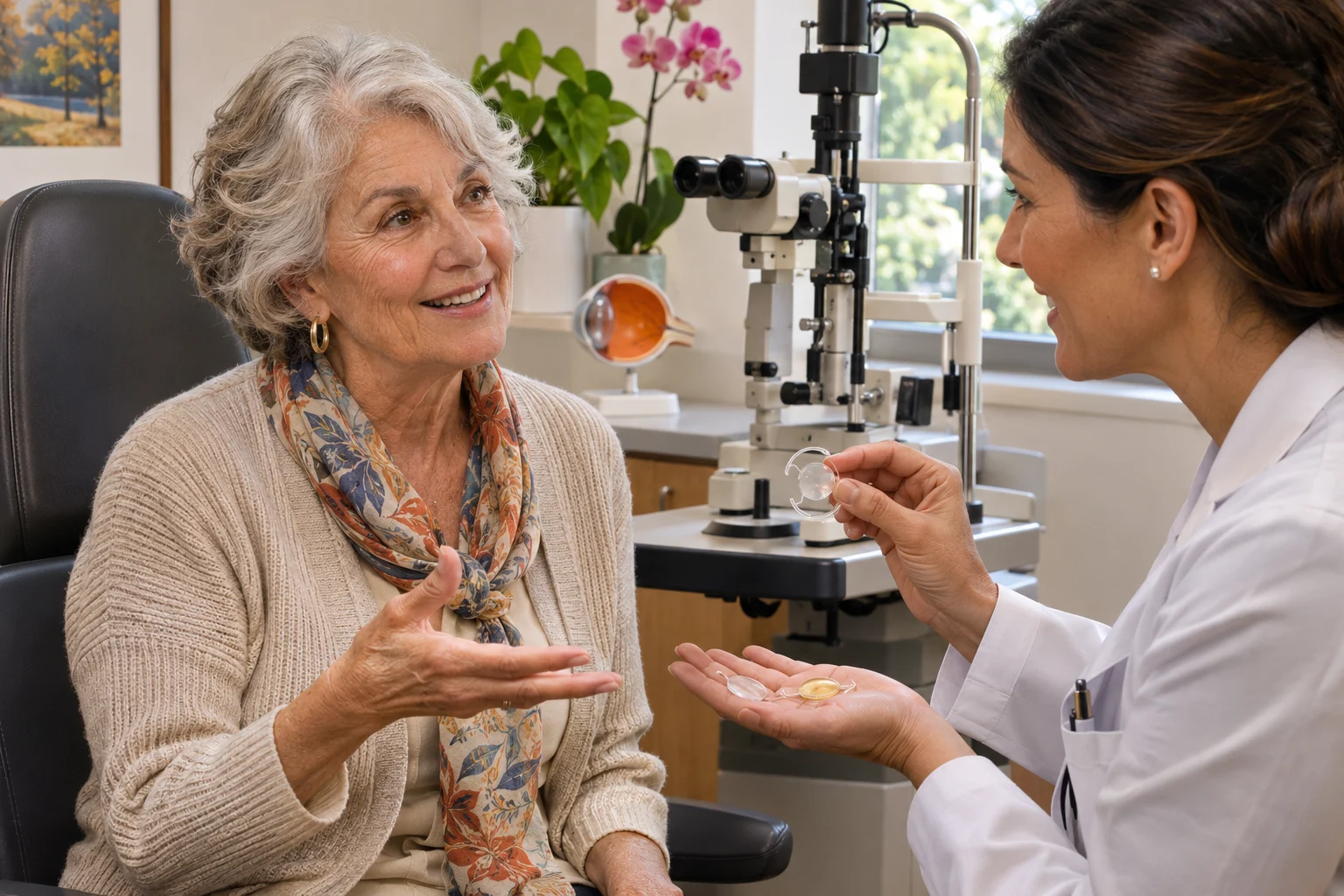
Before your appointment, think about the distances that matter to you. Do you want to see road signs clearly, read music at arm’s length, or thread a needle? Tell the surgeon which task matters most and when you’re happy to wear glasses. Eye measurements help determine the power of the implant. Your daily routine helps determine what to aim for.
A monofocal lens gives its clearest focus at one distance. If you choose distance vision, expect to use readers for small print. A near target is also possible. Some people choose a different focus in each eye, called monovision. Ask how that might affect depth perception. An enhanced monofocal lens may give you a little more range for a dashboard or computer screen.
A toric lens corrects regular corneal astigmatism, which can blur detail at several distances. “Toric” describes the astigmatism correction. A toric implant can also be monofocal or have a design that covers more than one distance. Your surgeon can explain whether your measurements make this worthwhile.
Extended depth-of-focus lenses generally cover distance and intermediate tasks, though you may still want readers for a medicine label. Multifocal and trifocal lenses can make reading up close without glasses easier. Their optics can also produce halos around headlights or reduce contrast in dim light. If you drive home on unlit roads every evening, mention that before choosing a lens. Ask what your insurance covers and what you would pay out of pocket.
Another option for some patients is a light-adjustable lens. It lets the doctor fine-tune the prescription after surgery, but requires extra appointments and special UV-protective glasses as directed. If you’re offered a newer lens or a calculation based on artificial intelligence, ask what benefit you can realistically expect for the activity you care about.
What should recovery feel like?
In the first few days, your eye may feel gritty, water easily or be sensitive to light. Vision can fluctuate as it heals. Use the prescribed drops, keep follow-up appointments and follow your surgeon’s instructions about swimming, lifting and rubbing the eye. Ask when you can drive again. Even when vision improves quickly, complete healing can take several weeks.
Call your eye surgeon immediately if vision suddenly worsens, pain becomes severe or increases, redness is pronounced, or you see flashes, a sudden shower of floaters or a dark curtain across your vision. If you cannot reach the team, seek emergency eye care. Infection inside the eye and retinal detachment are uncommon complications that need prompt treatment.
What if vision clouds over again months later?
The removed cataract cannot grow back. But the capsule supporting the implant can become cloudy months or years later, a change called posterior capsule opacification. If your ophthalmologist confirms this is the cause, a short outpatient laser procedure can open the cloudy part of the capsule. Have any new blur checked, since other eye conditions can cause a similar change.
Where does whole-eye transplantation fit in?
Headlines about eye transplants describe a different operation. In 2023, an NYU Langone team transplanted a donor eye as part of a partial face transplant. At one year, the eye still had a blood supply, but the recipient had not regained sight in it. Cataract surgery works by clearing the path that light takes through your own eye. The retina and its connection to the brain stay in place.
One question worth taking to your consultation is simple: “With the lens you recommend, which of my everyday tasks will probably still need glasses?” Whether the answer involves a book, a dashboard or a dark road, it gives you and your surgeon something specific to plan for.
Read the sources
- National Eye Institute (NEI). Cataracts. Information about symptoms, risk factors, diagnosis, and treatment.
- National Eye Institute (NEI). Cataract Surgery. Surgical procedures, visual outcomes, recovery, and complications.
- American Academy of Ophthalmology (AAO). Factors to Consider in Choosing an IOL for Cataract Surgery.
- American Academy of Ophthalmology (AAO). Cataract Surgery: Risks, Recovery, Costs.
- European Society of Cataract and Refractive Surgeons (ESCRS). ESCRS Recommendations for Cataract Surgery.
- American Academy of Ophthalmology. Cataract in the Adult Eye: Preferred Practice Pattern.
- National Health Service (NHS). Cataract Surgery. Information about preparation, recovery, and possible complications.
- NYU Langone Health (2023). NYU Langone Health Performs World's First Whole-Eye and Partial-Face Transplant.
- NYU Langone Health (2024). The World's First Whole-Eye and Partial-Face Transplant Recipient Achieves Remarkable Recovery.
- American Academy of Ophthalmology. What Parts of the Eye Can Be Transplanted?
- American Academy of Ophthalmology. What Are Cataracts?
This article explains selected evidence. It is not a systematic review or individual medical advice.