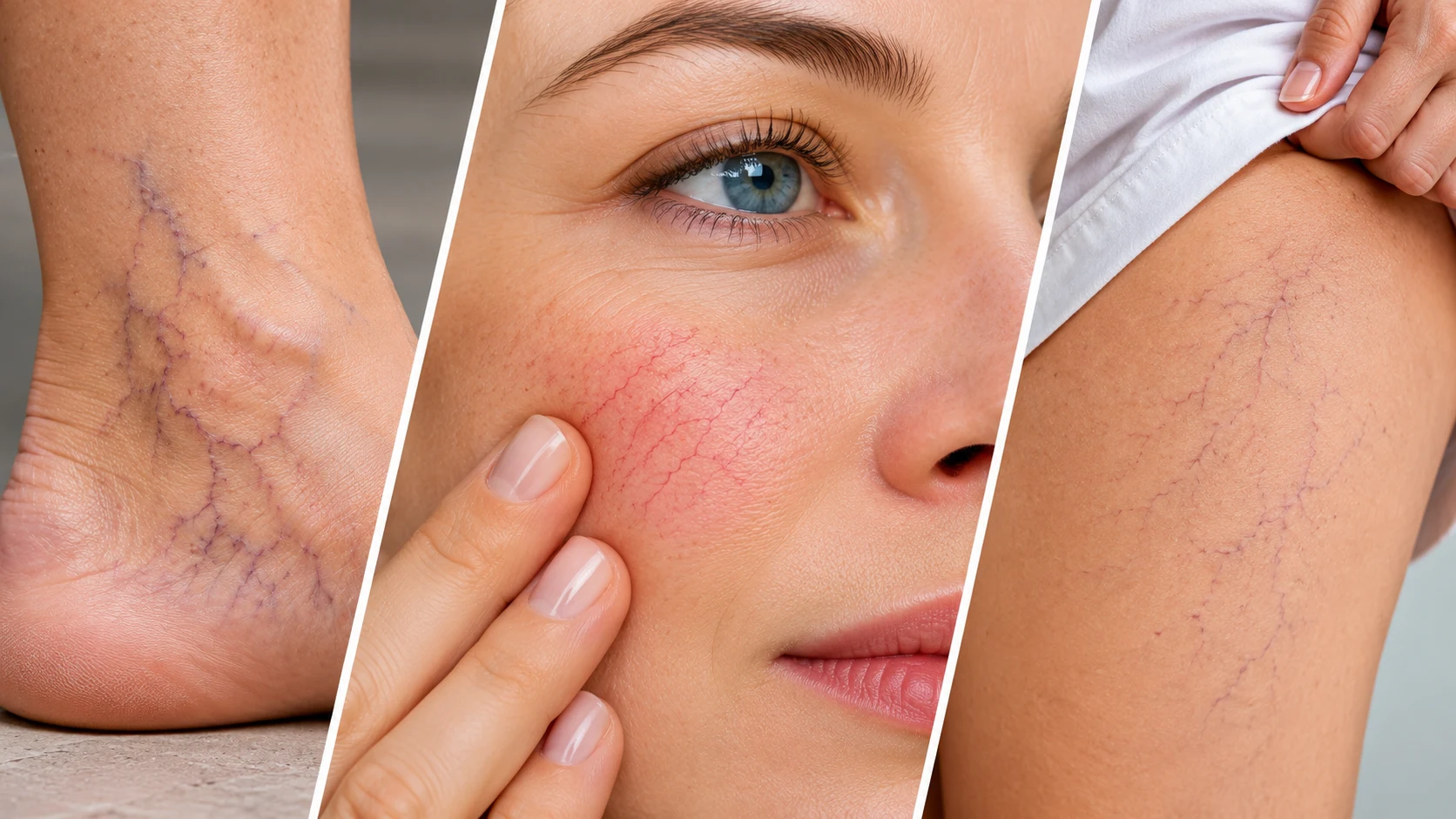
You notice a few blue lines around your ankle while fastening a sandal. Then you spot a fine red thread on your cheek. They look similar in the mirror, but a dermatologist and a vein specialist would ask different questions about them. Where did the vessels appear? Do they hurt? Has the surrounding skin changed?
What are spider veins?
Spider veins, also called telangiectasias, are tiny widened blood vessels close enough to the surface to show through the skin. They can look like red threads, blue lines or little purple branches. On the legs, they are usually less than a millimeter wide and lie flat. Slightly larger, blue-green vessels under the skin are called reticular veins. Varicose veins are larger still and often bulge or twist.
A few painless lines that have looked much the same for years can usually be left alone. A new fan of small vessels around an ankle deserves a closer look, especially if your sock leaves a deeper mark by evening or the skin above your shoe is getting itchy or darker.
Why do veins show through on the ankles and feet?
Thin skin and little padding can make healthy foot veins quite easy to see. Family history also helps explain why some people develop prominent leg veins early. Pregnancy can make them more noticeable as blood volume rises and the growing uterus puts pressure on veins in the pelvis. Some fade after delivery.
When you walk, your calf muscles squeeze blood back toward the heart. One-way valves help keep it moving upward. If a valve leaks, some blood flows backward and pressure builds farther down the leg. A clinician might suspect this from a combination of bulging veins, aching after a day on your feet and ankle swelling. The color of one vein tells you very little about how well its valves work.
When should I get leg veins checked?
Make an appointment if you develop persistent heaviness, swelling, itching, brown discoloration around the ankle or a sore that is slow to heal. A hard, tender vein also warrants assessment. If one leg suddenly becomes swollen and painful, get urgent medical care that day to check for a blood clot. Sudden shortness of breath or chest pain calls for emergency help. In the US, call 911.
If a varicose vein starts bleeding, lie down, raise the leg and press firmly on the spot with a clean cloth. Get emergency help if bleeding is heavy or continues despite pressure. Even if it stops, arrange prompt assessment because it can happen again.
Will I need an ultrasound?
A clinician can often identify ordinary spider veins by examining your skin. US vascular guidelines advise against routine ultrasound for someone whose only finding is small, symptom-free spider or reticular veins. For painful varicose veins, skin changes or suspected valve problems, a duplex ultrasound can show which way the blood is flowing. That can change the treatment plan, particularly if a leaking vein higher in the leg is feeding the visible veins below.
How well do injections work for leg spider veins?
In sclerotherapy, a clinician uses a fine needle to inject a solution or foam into a selected vein. Its walls close together and the vessel gradually fades. More than one session may be needed. A Cochrane review of 35 trials involving 3,632 participants found that injections improved the appearance of leg spider and reticular veins compared with placebo. The trade-offs included brown staining and a new mesh of very fine vessels around the treated area. Bruising and discomfort can also follow treatment.
In his explanation of foot veins, vein specialist Dr. Arnis Kudors raises a practical question: how much would treating this particular vein improve things for you? The ankle and foot have little soft tissue in places, with small arteries and nerves nearby. Rare complications of injections include skin injury and blood clots. For a painless vessel that only bothers you in sandals, leaving it alone is a reasonable choice.
Would laser treatment or surgery work better?
People use the term “laser treatment” for two quite different procedures. A surface laser directs light through the skin at small vessels. Endovenous laser ablation uses a fiber inside a larger vein to close it when its valves leak. A third option, miniphlebectomy, removes selected bulging veins through tiny openings in the skin. The best fit depends on the size of the vein, where it runs and what symptoms you want to relieve.
Before booking a cosmetic procedure, ask what improvement is realistic for your skin tone and the location being treated. Surface lasers can cause burns, pigment changes and, occasionally, scarring. Successfully treating one vessel also leaves open the possibility of new ones appearing over time.
What about red vessels on my cheeks or nose?
Sun exposure, age and family traits can make fine facial vessels more visible. If your cheeks also flush, sting or develop small bumps, ask a dermatologist about rosacea. Long-term use of a strong steroid cream on the face can also leave visible vessels. Mention any creams you use when you go for an assessment.
A gentle cleanser, moisturizer and daily sunscreen can help care for sensitive skin. Prescription rosacea treatments can ease inflammation or temporarily reduce background redness. An established red thread may still be visible even after the surrounding skin feels better.
For individual facial vessels, a dermatologist may suggest a vascular laser or intense pulsed light (IPL). A laser uses a particular wavelength, while IPL uses a range of wavelengths. The clinician selects settings for your skin tone and the depth and size of the vessels. Several sessions may be needed. For a few tiny vessels, a dermatologist may also consider treatment with an electric current. Injections used on the legs are generally avoided for routine facial spider veins because of the delicate circulation near the eyes.
Can similar marks appear on the ears, chest or arms?
Yes. Sun-exposed areas such as the ears and upper chest can develop fine vessels, too. A red dot with tiny branches radiating outward may be a spider angioma. One on its own is common. If many appear over a short period, or you also have frequent nosebleeds and relatives with similar symptoms, mention those details to your doctor. They can help determine whether an examination beyond the skin is worthwhile.
What can I do at home?
If your legs feel heavy after standing, try a walk or a few ankle movements when you have been sitting for a while. Your calf muscles help blood move up the leg. Properly fitted compression stockings can ease swelling and aching for some people. Ask about the right fit and pressure, especially if you have peripheral artery disease.
Walking, stockings, creams and supplements will not reliably erase an existing spider vein. If appearance is your main concern, it is reasonable to talk about that, too. Describe what bothers you most: a single vessel on your cheek, shoes that get tight by evening, or a patch on your ankle that has recently changed. Those details help your clinician decide whether skin care, a cosmetic procedure or a vein examination would actually address your concern.
Read the sources
- Gloviczki, P., et al. (2023). The 2023 Society for Vascular Surgery, American Venous Forum, and American Vein and Lymphatic Society Clinical Practice Guidelines for the Management of Varicose Veins of the Lower Extremities. Part II. Journal of Vascular Surgery: Venous and Lymphatic Disorders.
- Nakano, L. C. U., Cacione, D. G., Baptista-Silva, J. C. C., & Flumignan, R. L. G. (2021). Treatment for Telangiectasias and Reticular Veins. Cochrane Database of Systematic Reviews.
- International Union of Phlebology. (2023). Sclerotherapy of Lower Limb Veins: Indications, Contraindications and Treatment Strategies to Prevent Complications.
- National Institute for Health and Care Excellence (NICE). Varicose Veins: Diagnosis and Management. Guideline CG168.
- American Academy of Dermatology (AAD). Rosacea: Diagnosis and Treatment.
- American Academy of Dermatology (AAD). Lasers and Lights: How Well Do They Treat Rosacea?
- DermNet. Telangiectasia.
- National Health Service (NHS). Varicose Veins.
- NHS. Deep vein thrombosis (DVT).
This article explains selected evidence. It is not a systematic review or individual medical advice.