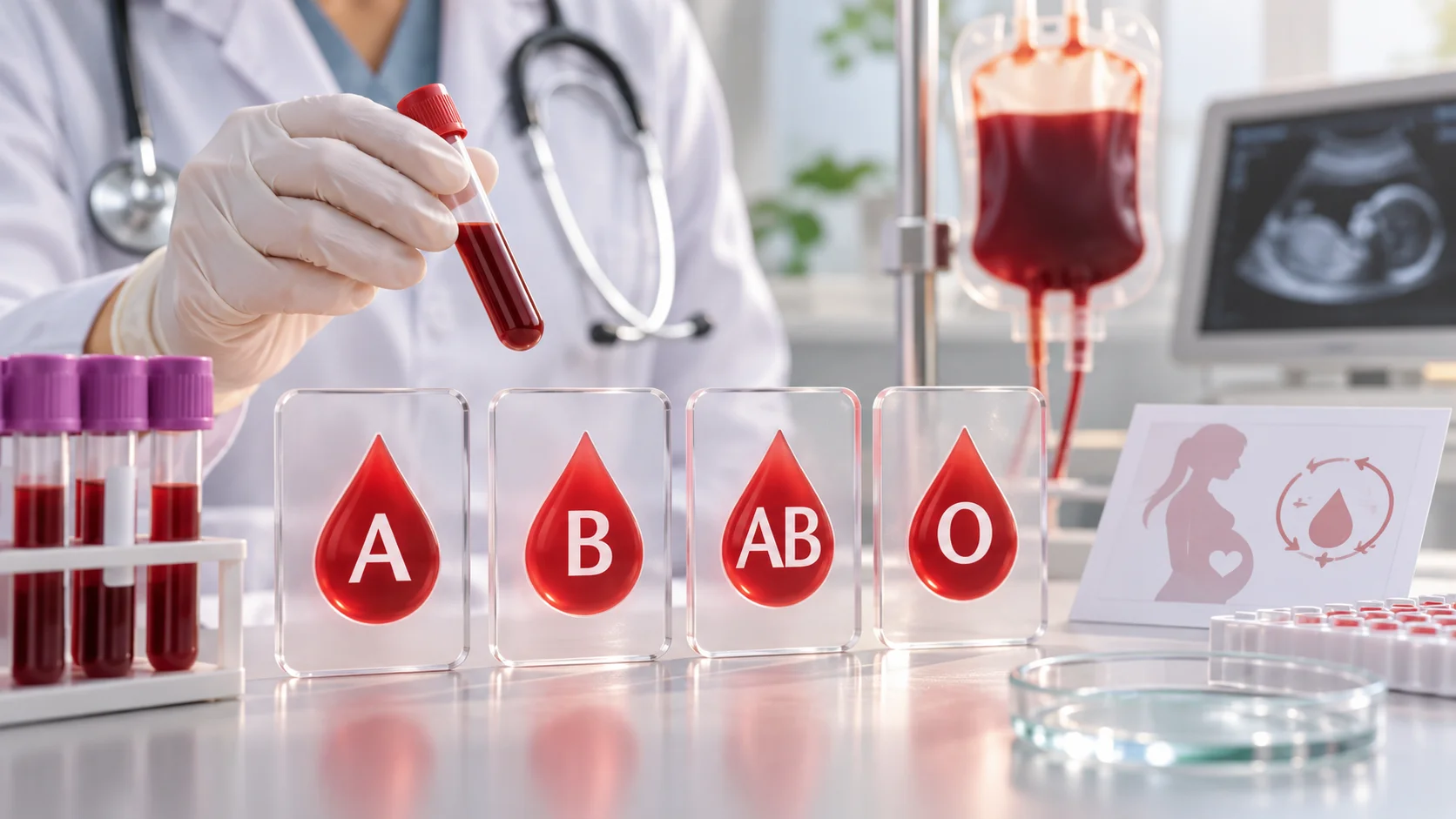
A donor card might give your blood type in two characters, such as A+. Before a transfusion, a hospital still tests a fresh sample. At a first prenatal visit, the laboratory checks for blood group antibodies even if you already know you’re Rh-positive. What are those tests looking for that a letter and a plus sign can’t tell you?
What do A, B, AB and O mean?
Red blood cells carry oxygen. On their surface are inherited markers called antigens. In the ABO system, the letters tell you which of two markers, A and B, your red cells carry. The liquid portion of your blood, called plasma, typically contains antibodies against the ABO markers your own cells lack.
| Blood type | ABO markers on red cells | Usual ABO antibodies in plasma |
|---|---|---|
| A | A | Anti-B |
| B | B | Anti-A |
| AB | A and B | Neither anti-A nor anti-B |
| O | Neither A nor B | Both anti-A and anti-B |
The plus or minus sign describes a different marker, the D antigen in the Rh system. A person with A+ and a person with A− both have the A marker. Only the first has the usual D marker. Both people also have many markers their donor cards never mention. In September 2026, the International Society of Blood Transfusion recognized its 49th blood group system, called JAMA.
Why test again before a transfusion?
Consider a patient with type A blood who mistakenly receives type B red cells. The patient’s anti-B antibodies can attach to and destroy those cells. A severe reaction can cause shock, kidney injury or death. In 1901, Karl Landsteiner published observations that helped explain why blood from some people clumped when mixed with blood from others. His work on blood groups earned the 1930 Nobel Prize in Physiology or Medicine.
Today the hospital checks the patient’s identity and tests the sample for ABO and RhD type. An antibody screen looks for antibodies to other red-cell markers, such as Kell or Kidd. A crossmatch checks compatibility with the selected donor unit. A pregnancy or an earlier transfusion may have exposed a patient to markers their own cells lack. If you’ve ever been given a card identifying a red-cell antibody, show it to your care team, even if the transfusion was years ago.
Matching reduces the risk of a reaction, but even compatible blood can cause complications. If you develop chills, fever, new pain or trouble breathing during a transfusion, alert the nurse immediately.
Why can O-negative red cells and AB plasma both be called universal?
They are different parts of a donation. In an emergency, O-negative red cells can provide oxygen before a patient’s type is known because those cells lack A, B and D. Someone with AB-positive blood can receive red cells from any of the eight familiar ABO/RhD types, provided the unit is otherwise compatible. Other antibodies can still matter in either situation.
For plasma, the question runs in the opposite direction: could antibodies in the donor plasma attack the patient’s red cells? AB plasma usually contains neither anti-A nor anti-B, so it can be given across ABO groups. Whole blood contains both cells and plasma and has its own matching rules.
Can two type A parents have a type O child?
Yes. In the usual inheritance pattern, a person with type A blood may carry either two A variants of the ABO gene or one A and one O. If both parents carry A and O, each can pass on O. A child who inherits O from both will usually have type O blood. Rare variants complicate family predictions, and a blood type cannot establish parentage.
O-positive is the most common of the eight familiar types in the U.S. AB-negative is the least common. Frequencies vary across populations, and there are much rarer combinations outside those eight labels. For example, Rh-null red cells lack all Rh antigens, while ordinary Rh-negative red cells lack D but generally carry other Rh antigens. That difference can make finding a suitable donor particularly difficult for a patient with Rh-null blood.
Your inherited blood type usually stays the same throughout life. One unusual exception is a donor stem cell transplant: when the donor’s cells take over blood production in the bone marrow, newly made red cells can carry the donor’s blood type.
What does Rh-negative mean during pregnancy?
An Rh-negative result by itself does not mean there is a problem with the pregnancy. If the fetus is RhD-positive and some fetal red cells enter the pregnant patient’s circulation, the patient can develop anti-D antibodies. This is called sensitization. Those antibodies can cross the placenta and destroy fetal red cells, causing anemia in an affected pregnancy. After birth, an affected baby may also develop jaundice.
Early prenatal blood work includes both blood typing and an antibody screen. In the U.S., an RhD-negative patient who has not developed immune anti-D will commonly be offered Rh immune globulin around week 28 and again within 72 hours after delivery if the newborn is RhD-positive. Bleeding, abdominal trauma and certain procedures can also prompt the prenatal team to assess whether a dose is needed.
Rh immune globulin helps prevent sensitization. If immune anti-D is already present, the care team instead assesses the risk to the fetus and plans monitoring. Antibodies to other markers, including K and c, can also affect a pregnancy. That is why the prenatal antibody screen matters for Rh-positive patients as well.
Does blood type tell you anything about disease risk?
One of the clearer associations involves clots in veins, such as a deep vein thrombosis in the leg or a pulmonary embolism in the lungs. Studies generally find higher rates among people with A, B or AB blood than among those with O. One possible explanation is that people with non-O blood tend to have higher levels of two proteins involved in clotting, von Willebrand factor and factor VIII.
These are differences between groups. A person with O blood can still develop a clot after surgery or prolonged immobility. A blood type alone is no reason to start aspirin or an anticoagulant. A clot in a vein is also a different outcome from a heart attack. For heart disease prevention, blood pressure, LDL cholesterol, diabetes and smoking are more useful things to discuss at a checkup.
Some infections show associations with blood group markers, too. Different strains of norovirus, for example, can interact differently with markers on cells lining the gut. Other inherited traits matter as well. Knowing your ABO type will not tell you whether you’ll catch a particular stomach bug.
Should you eat for your blood type?
There is no convincing evidence that matching a diet to A, B, AB or O improves health. If adding vegetables or eating more whole grains helps someone with type A blood, their type is no reason to give different advice to someone with type O. Blood type is also a poor predictor of personality.
What happens to a blood donation?
A patient with severe anemia may need red cells, while someone with too few platelets may need platelets to help stop bleeding. Plasma supplies clotting proteins. Blood centers test donations for specified infections, determine blood type and prepare components for storage. Depending on how they are prepared, red cells can be stored for up to 42 days. Platelets have a much shorter shelf life, so hospitals need a continuing supply of donors of many types.
If you want to find out your blood type, look for a result in your prenatal, transfusion or blood donation records, or ask your clinician whether testing would be useful. If you are considering donation, check your local blood center’s current eligibility criteria. And if you need emergency care, you can get help without knowing your type. The hospital has procedures for providing blood while testing is underway.
Based on material provided by Dr. Liene Pabērza. English adaptation by VitalMeGuide.
Read the sources
- International Society of Blood Transfusion (ISBT). Red Cell Immunogenetics and Blood Group Terminology. Updated September 24, 2026.
- The Nobel Prize. Karl Landsteiner – Facts. Nobel Prize in Physiology or Medicine 1930.
- National Center for Biotechnology Information (NCBI). ABO Blood Group. Bookshelf.
- American Red Cross. Blood Types Explained: A, B, AB and O.
- American Red Cross. AB Positive and AB Negative Blood Types.
- American Red Cross. Facts About the Blood Supply in the United States.
- American College of Obstetricians and Gynecologists (ACOG). The Rh Factor: How It Can Affect Your Pregnancy.
- ABO and Rhesus Blood Groups and Multiple Health Outcomes: An Umbrella Review of Systematic Reviews With Meta-Analyses of Observational Studies. (2024). BMC Medicine.
- Pulmonary Embolism and ABO Blood Type: A Systematic Review. (2025). PubMed.
- ABO Blood Group-Associated Susceptibility to Norovirus Infection: A Systematic Review and Meta-Analysis. (2020). PubMed.
- Franchini, M., Maggi, F., & Focosi, D. (2024). ABO Blood Group-Related Mechanism of Infection of SARS-CoV-2: An Overview of Systematic Reviews. Clinical Chemistry and Laboratory Medicine.
- Cusack, L., De Buck, E., Compernolle, V., & Vandekerckhove, P. (2013). Blood Type Diets Lack Supporting Evidence: A Systematic Review. American Journal of Clinical Nutrition, 98(1), 99–104.
- Nawata, K. (2014). No Relationship Between Blood Type and Personality: Evidence From Large-Scale Surveys in Japan and the US. Japanese Journal of Psychology, 85(2), 148–156.
- Association for the Advancement of Blood & Biotherapies (AABB). Frequently Asked Questions About Blood and Blood Donation.
- National Association of EMS Physicians. (2025). Prehospital Trauma Compendium: Transfusion of Blood Products in Trauma.
- International Society of Blood Transfusion. Meet JAMA, the 49th ISBT blood group system (September 2026).
This article explains selected evidence. It is not a systematic review or individual medical advice.