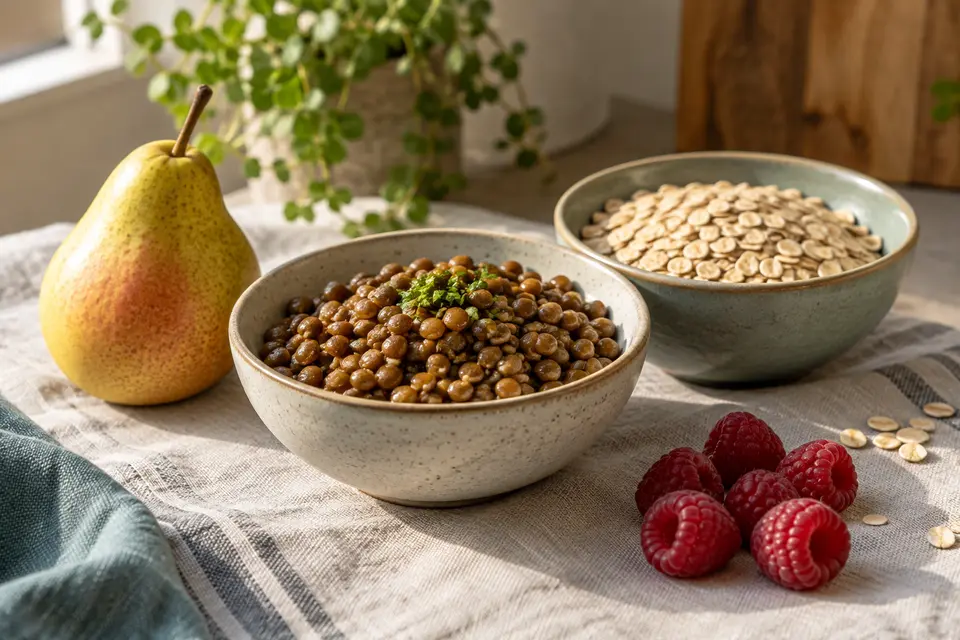
The FDA Daily Value for dietary fiber is 28 grams. It is a reference for understanding food labels, not a personalized prescription or a pass/fail score for your day.
A cereal box shows grams of fiber and a percentage. You pour a bowl, add something else and move on. The number looks precise, but applying it to your meal depends on a detail that is easy to overlook: how much of the stated serving you actually ate.
Read the serving before the percentage
The FDA explains that percent Daily Value shows how much a nutrient in one serving contributes to the daily reference. For dietary fiber, that reference is 28 g. As a general label guide, 5% DV or less is low and 20% DV or more is high. These percentages refer to a serving of the food. [1]
Before comparing two packets, check whether they describe comparable portions. A large serving can contain more fiber than a small serving even when the food itself is not more fiber-dense. Neither number is wrong; they answer different questions.
A worked example
Suppose an imaginary food label lists 4 g of fiber per serving. Here is how the arithmetic changes with the amount eaten:
| Servings eaten | Calculation | Fiber |
|---|---|---|
| Half a serving | 4 × 0.5 | 2 g |
| One serving | 4 × 1 | 4 g |
| One and a half | 4 × 1.5 | 6 g |
Six grams is about 21% of the 28 g reference: 6 ÷ 28 × 100. Food labels may round their displayed numbers, so calculator results and printed percentages need not match perfectly.
Why 28 is not everyone's exact target
NIDDK describes adult fiber needs as varying with age and sex. Its constipation nutrition guidance advises adding fiber gradually and getting enough liquids, with individual needs discussed with a health professional. It lists whole grains, legumes, fruits, vegetables and nuts among fiber sources. [2]
A label reference is useful because it gives packages a common comparison point. That usefulness does not turn it into an individualized nutrition plan. If you follow a prescribed diet, use the advice that applies to your situation rather than trying to make a website's meter reach a particular number.
Use the counter as a notebook
Our label-based fiber counter multiplies the fiber per serving by the servings entered, then adds the results. Enter grams of fiber, not the weight of the entire food. For a food without a label, you need a reliable value for the food and portion you actually used; the tool does not estimate it for you.
If you enter only breakfast, the result describes only the breakfast entries. If you forget a food, the tool cannot know. A low total does not diagnose a deficiency, and a high total does not establish that the rest of your diet meets your needs.
A useful first exercise
- Choose one food you already eat.
- Find its serving size and grams of dietary fiber.
- Compare the stated portion with your portion.
- Enter the values and check the calculation.
- Ask what the example taught you, rather than treating one meal as a verdict.
You can repeat the exercise on another day if it helps you understand your routine. Your entries remain in the current browser page and disappear when it reloads.
Read the sources
This article explains selected evidence. It is not a systematic review or individual medical advice.