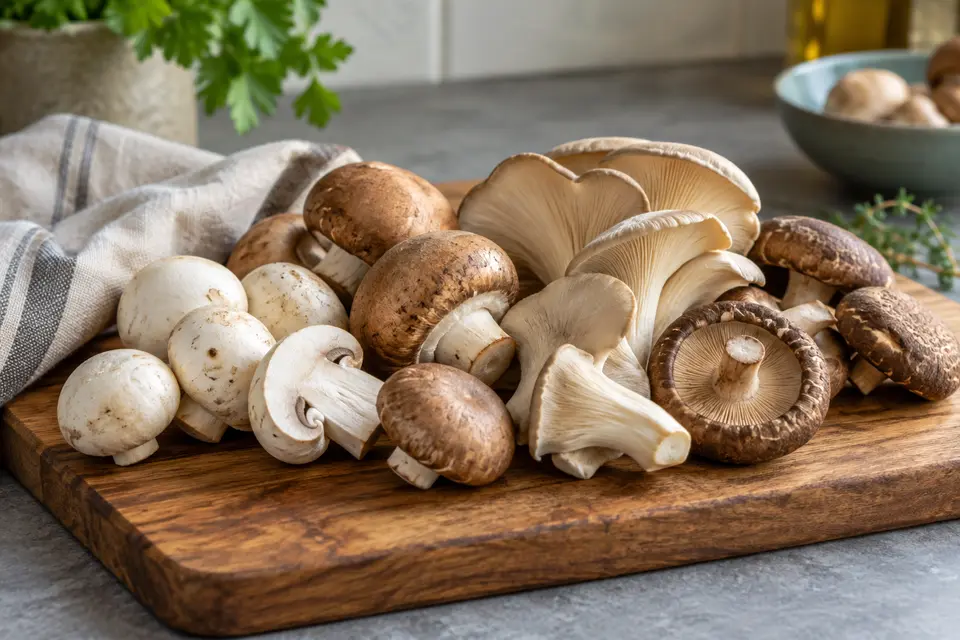
Everyday mushrooms can add flavor, variety and nutrients to your meals. Their protein contribution is modest, vitamin D varies, and the way you prepare them matters.
Mushroom sauce may bring autumn to mind, but mushrooms can have a place on your plate throughout the year. Alongside familiar white buttons, stores offer oyster mushrooms, large portobello caps and shiitake. Which should you choose, what do they contribute nutritionally, and does a higher price necessarily mean greater value?
Start with a practical question: what are you cooking tonight? Different textures and flavors suit different dishes. You do not need to expect a medicinal effect to enjoy mushrooms as food.
Five mushrooms you may find at the store
White button mushrooms are a versatile starting point for soups, omelets, stews and sauces. Their relatively mild flavor works with many other ingredients.
Cremini mushrooms, also spelled crimini and sold as brown mushrooms or baby bellas, generally have a deeper mushroom flavor. Try them in recipes that would otherwise use white buttons.
Portobello mushrooms are large, mature mushrooms of the same species as white buttons and cremini. Their broad caps work well for stuffing or roasting. A firm, meaty texture does not mean they provide as much protein as meat. [1] [2]
Oyster mushrooms can be torn into pieces for skillet dishes, pasta or stews. Trim away the tough base that holds the cluster together.
Shiitake mushrooms bring a pronounced savory flavor to broths, soups and noodle dishes. The tough stems are usually removed. Prepare dried shiitake according to the package instructions; soaking does not replace cooking. [2] [3]
What does 100 grams actually provide?
This table compares fresh, raw mushrooms without added ingredients. That gives us a consistent basis for comparison; it is not advice to eat them uncooked. One hundred grams is about 3.5 ounces.
| Mushroom | Calories (kcal) | Protein (g) | Fiber (g) |
|---|---|---|---|
| White button | 22 | 3.1 | 1.0 |
| Cremini | 22 | 2.5 | 0.6 |
| Portobello | 22 | 2.1 | 1.3 |
| Oyster | 33 | 3.3 | 2.3 |
| Shiitake | 34 | 2.2 | 2.5 |
Source: USDA Standard Reference 28; values rounded. Actual composition varies between samples and growing conditions. These are reference values, not laboratory results for your particular package. [1]
These fresh mushrooms are low in calories and provide a modest amount of protein. A serving can contribute to a meal, but mushrooms alone do not replace its main protein source. A general claim that every 100 g of fresh mushrooms contains 5–7 g of fiber does not fit these examples.
Comparing fresh and dried mushrooms by the same weight can be misleading. Drying removes water, concentrating nutrients into a smaller weight. Cooking also changes water content, while added oil or butter changes the finished dish's calorie content.
B vitamins are part of the picture. Vitamin D needs a closer look.
These mushrooms contain several B vitamins, including riboflavin (B2), niacin (B3) and pantothenic acid (B5). They also contain minerals such as potassium, copper and selenium, with amounts varying between varieties. [1]
For vitamin D, the variety name alone is not enough. Mushrooms can produce vitamin D2 when exposed to ultraviolet light. Some commercially available mushrooms are specifically UV-treated to increase their vitamin D content. If vitamin D is your reason for choosing a product, check its label and the amount per serving. Do not assume that every pack of button mushrooms or shiitake provides the same amount. [4]
What about beta-glucans?
Mushroom cell walls contain chitin and beta-glucans. Researchers are interested in these compounds, but beta-glucans are not all alike: their structure and properties depend on their source. [5]
Evidence for particular effects of oat beta-glucans cannot simply be transferred to a mushroom meal. Likewise, research involving a purified mushroom extract does not establish the same effect for an ordinary serving. We should not present mushrooms as a guaranteed way to lower cholesterol or blood glucose. [5] [6]
How to prepare and store them
Keep fresh mushrooms in the refrigerator, in their original packaging as directed by the producer or in a paper bag. Clean them before cooking and give them a brief rinse if needed. [7]
Cook shiitake thoroughly. Raw or undercooked shiitake can cause a very itchy, streak-like rash in some people. France's food safety agency ANSES notes that very brief cooking may not be enough. Previously dried shiitake also need proper cooking. [3]
Freezing is a practical way to keep mushrooms for later without preserving them in salt. The National Center for Home Food Preservation recommends steaming or cooking mushrooms in a pan before freezing, then cooling them promptly and packaging them. [8]
For a meal idea, cook mushrooms with vegetables, add buckwheat or another grain, and include a protein source such as beans, tofu, an egg or fish. The mushrooms bring flavor and variety to the plate.
With wild mushrooms, reliable identification comes first. If you are unsure of the species, do not use it in food. This article is not a foraging identification guide. [9]
What's on your plate?
Which mushrooms do you cook most often: white buttons, oyster mushrooms or shiitake? Share a favorite dish in our community discussions.
Join the conversationRead the sources
- USDA · Standard Reference 28 · Raw mushrooms: NDB 11260, 11266, 11265, 11987 and 11238
- Mushroom Council · Varieties · Industry source used for culinary descriptions
- ANSES · Vigil’Anses March 2021 · Shiitake cooking and dermatitis, pages 6–9
- NIH Office of Dietary Supplements · Vitamin D fact sheet
- Cerletti et al. · Edible Mushrooms and Beta-Glucans: Impact on Human Health · 2021 review
- EFSA · Oat beta-glucans and postprandial glucose peaks · 2026 · Oat-specific assessment
- Penn State Extension · Preparing and Preserving Mushrooms
- National Center for Home Food Preservation · Freezing Mushrooms
- BfR · Mushroom poisoning: mix-ups can be fatal
This article explains selected evidence. It is not a systematic review or individual medical advice.