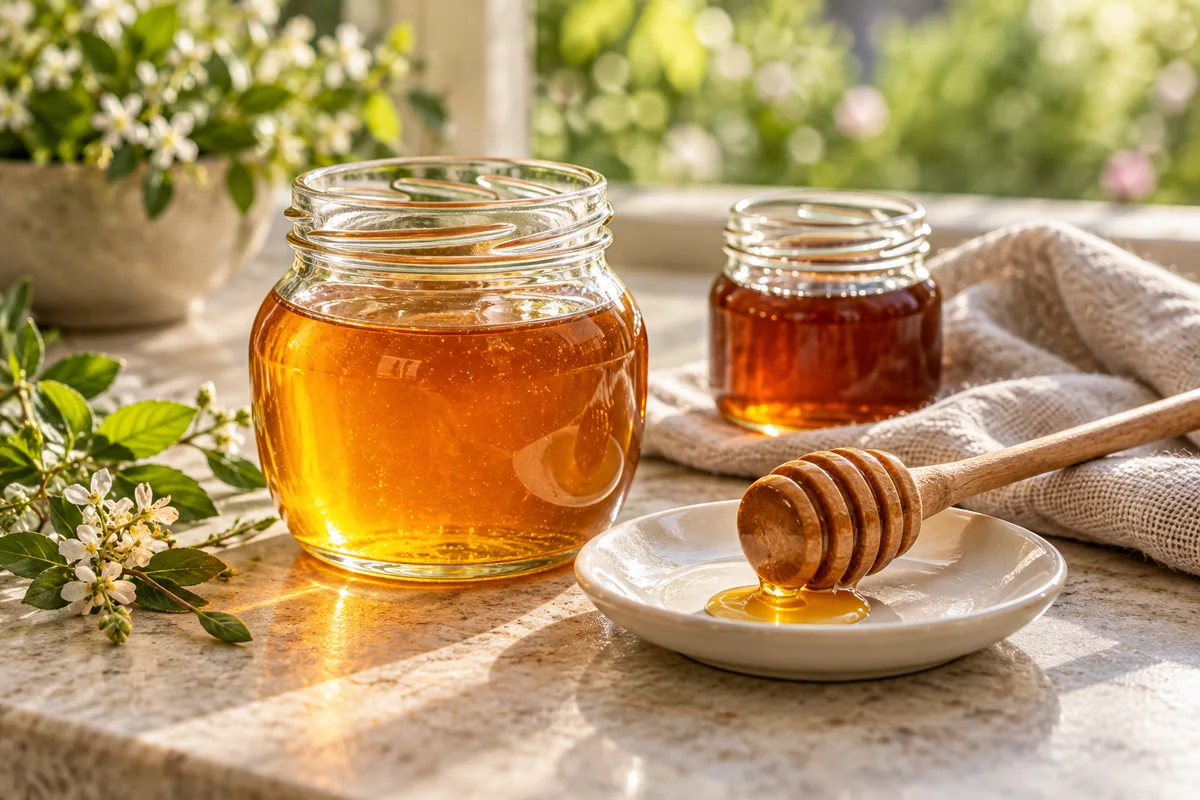
Some people keep a jar of honey ready for winter tea and sore throats. Others see it as little more than sugar with a wholesome reputation. Is honey a useful natural food, or have we given it more credit than the evidence supports?
The answer depends on what we expect it to do. Honey contains more than sugars, and it has some useful applications. But its natural origin does not make its sugar content disappear—or turn a spoonful into medicine for every illness.
More than table sugar, but still mostly sugars
From a nutritional perspective, honey is primarily a source of sugar. Fructose and glucose make up most of its carbohydrate content, with smaller amounts of sucrose and other sugars. Water accounts for roughly 17–20% of its weight. Protein and amino acids are present in very small amounts.
Honey also contains organic acids, enzymes, peptides and plant compounds such as polyphenols, including flavonoids. Its precise composition varies with the flowers visited by bees and with processing and storage.
Researchers study these compounds for their antioxidant, antimicrobial and anti-inflammatory activity. Antioxidant activity, for example, can be measured in laboratory tests of reactions involving free radicals.
Those findings do not automatically show that eating honey prevents disease, strengthens immunity or treats inflammation in people. Honey is chemically more complex than table sugar, but that is different from proving a substantial health benefit from everyday portions.
Can honey replace vitamins?
Honey contains traces of some B vitamins, vitamin C and minerals such as potassium, calcium, magnesium and iron. The amounts in a typical serving are too small to make it a meaningful vitamin or mineral source.
Trying to obtain significant amounts of these nutrients from honey would mean eating a great deal of sugar. A varied diet is a much more useful way to meet nutritional needs.
The World Health Organization recommends keeping free sugars below 10% of daily energy intake and suggests reducing them below 5% for additional benefits, particularly for dental health. The sugars naturally present in honey count as free sugars.
On a 2,000-calorie eating pattern, those thresholds correspond to less than about 50 grams and 25 grams of free sugars a day, respectively. They refer to all free sugars combined, not an allowance for honey on top of other sweet foods and drinks.
Is one type of honey healthier than another?
Honey varies in color, aroma, flavor and composition. In laboratory studies, darker varieties often contain more phenolic compounds and show greater antioxidant activity. Buckwheat and heather honeys are examples studied for these characteristics; linden and mixed-flower honeys also contain plant compounds.
However, a higher antioxidant reading in a laboratory does not establish that one variety leads to better health outcomes when eaten. There is no well-established “healthiest honey” that everyone needs to buy.
The balance of glucose and fructose can also vary and may influence the blood glucose response. A higher proportion of fructose does not make a honey sugar-free or suitable for unlimited use by someone with diabetes.
For everyday eating, choose a honey you enjoy and pay attention to the amount. Differences in flavor and color are usually more useful shopping considerations than broad promises about health.
How much honey is a reasonable amount?
Honey is a concentrated source of energy. USDA reference values put one tablespoon of honey at about 64 calories and 17 grams of carbohydrate, almost all of it sugar. One teaspoon provides approximately 21 calories and 6 grams of carbohydrate.
For comparison, 100 grams—about 3.5 ounces—contains roughly 304 calories and 82 grams of carbohydrate. These are approximate values; the product label is useful when you need to count a specific serving.
One or two teaspoons can be a modest serving, but this is not a universal medical daily dose or a recommendation that everyone should eat honey. Whether it fits your diet depends on your overall sugar intake, energy needs and health conditions.
A teaspoon in tea is easy to overlook when there is also honey on toast, sweetened yogurt and other sugary drinks during the day. The total matters more than the reputation of any one sweetener.
Can honey help a cough?
Relief of a short-term cough is one of honey’s better-studied uses. The American Academy of Pediatrics includes honey as an option for children ages 1 and older. Never give honey to a child younger than 12 months.
A 2018 Cochrane review found that honey probably offers some relief compared with no treatment or placebo, including less nighttime coughing and less disruption to sleep. Many studies were small and assessed only a short period of treatment.
Later reviews have also reported possible benefits, while emphasizing limitations in the evidence. A 2023 review rated the evidence as low quality; a 2026 review comparing honey with cough medicines rated the certainty as very low. These results support cautious expectations, not a promise that honey works better than every cough medicine.
Honey may help soothe an irritated throat. Its thick consistency and effects on saliva are possible explanations, but the exact mechanism of cough relief is not fully established.
Relieving a symptom is different from treating its cause. Honey does not cure a viral infection or replace antibiotics when a clinician determines that they are needed. Breathing difficulty or a child who is becoming very unwell needs medical attention; a persistent or worsening cough should be assessed rather than repeatedly treated at home.
What explains honey’s antimicrobial activity?
Several features help explain why honey can inhibit microbes under particular conditions. Its high sugar concentration leaves little water available for microbial growth, and its acidity is unfavorable to many bacteria.
An enzyme called glucose oxidase can contribute to hydrogen peroxide production under suitable conditions. Other substances, including certain peptides and plant compounds, can also contribute to antimicrobial activity. Their amounts and effects vary between honeys.
Laboratory experiments involving bacteria such as staphylococci and streptococci help researchers explore these mechanisms. They do not establish that swallowing honey disinfects the throat or treats a bacterial infection inside the body.
What about honey for wounds?
Honey has a separate role in some wound-care products. These use medical-grade honey prepared and sterilized for that purpose, including honey-containing dressings.
A Cochrane review found benefits in certain comparisons involving partial-thickness burns and infected surgical wounds, but evidence for many other wound types was uncertain or of low quality. This is not a reason to assume honey is the best treatment for every wound.
Do not put ordinary food honey from a kitchen jar on an open wound. It is not sterile and is not interchangeable with a medical dressing. A healthcare professional should decide whether a medical honey product is appropriate for the wound.
How should you use honey in drinks?
If you enjoy honey in tea, letting the drink cool slightly before adding it can help preserve some heat-sensitive enzymes and aromatic compounds. Prolonged or intense heating can change honey’s composition.
Preserving an enzyme, however, is not the same as proving an extra health benefit from drinking it. Adding honey to a hot drink does not automatically make the drink harmful.
Warm water with honey and lemon can be a pleasant drink. It does not “detox” the body or automatically speed up metabolism. The honey still contributes sugar and calories, and frequent sipping of sweet drinks is not ideal for teeth.
Why does honey crystallize—and can you warm it?
Honey can become thick and grainy as glucose forms crystals. Crystallization is a natural process and, by itself, does not mean the honey has spoiled. Different varieties crystallize at different rates.
To soften it, place the jar in a gently warm water bath. Water around 104°F (40°C) is a cautious way to warm it slowly while limiting heat exposure. That temperature is a quality-preservation choice, not a precise medical boundary between “healthy” and “unhealthy” honey.
Heating and prolonged storage can increase a compound called 5-hydroxymethylfurfural, or HMF. It is used as one indicator of honey’s quality and heat or storage history, and it also occurs in many other foods.
Researchers have studied potential toxic effects of HMF and its metabolites, but laboratory and animal findings do not establish that the amounts ordinarily present in honey cause cancer in people. Avoid claims that a spoonful added to hot tea becomes poisonous.
The practical approach is simple: avoid unnecessarily prolonged heating and store honey in a closed container away from excessive heat.
Who needs to be cautious?
Infants under 12 months must not have honey. It can contain Clostridium botulinum spores, which may grow in an infant’s intestines and produce a toxin. Infant botulism is uncommon but can be very serious. Do not add honey to an infant’s food, water, formula or pacifier.
People with a known honey allergy should avoid it. Honey can contain pollen and other substances that may trigger reactions in susceptible people. An allergy to another bee product does not automatically prove a honey allergy; discuss an uncertain history with a healthcare professional.
For people with diabetes, honey is not a sugar-free alternative. It can raise blood glucose and needs to be included in carbohydrate counting. A tablespoon contains about 17 grams of carbohydrate, slightly more than one 15-gram carbohydrate choice.
People managing weight or metabolic conditions should also consider portions within their overall eating pattern. “Natural” is not a reason to ignore the amount.
Enjoy the flavor, keep the claims in perspective
Honey is a complex food with interesting compounds and some specific uses supported by research. It can offer short-term cough relief for some people, and medical-grade honey has selected applications in wound care.
It is also mostly sugar, provides few vitamins or minerals in ordinary portions, and is neither essential to a healthy diet nor a universal remedy.
You do not have to avoid honey simply because it contains sugar. But eating more of it is not a shortcut to better health. Enjoy a small amount for its flavor, account for it in your overall diet, and keep its benefits in proportion.
Original material prepared by Dr. Guna Havensone. English translation and evidence clarifications by VitalMeGuide with AI assistance. Clarifications distinguish laboratory findings from clinical benefits, qualify cough and wound-care evidence, and explain heating and portion sizes. This edited English version has not been confirmed as reviewed by the original author. Sources checked October 21, 2026.
Read the sources
- World Health Organization · Guideline: sugars intake for adults and children · 2015
- USDA · FoodData Central: Honey · FDC 169640
- USDA · Standard Reference 28: Honey, NDB 19296 · Nutrient tables, pp. 480–482
- Oduwole et al. · Honey for acute cough in children · Cochrane · 2018
- Kuitunen and Renko · Honey for acute cough in children: a systematic review · 2023
- Honey vs. pharmacological treatment for acute cough in children: systematic review and meta-analysis · 2026
- American Academy of Pediatrics · Coughs and colds: medicines or home remedies?
- CDC · Foods and drinks to avoid or limit: honey before 12 months
- Cochrane · Honey as a topical treatment for acute and chronic wounds · 2015
- Oxford Health NHS Foundation Trust · Medical honey simplified
- The relationship between browning, phenolics, color and antioxidant activity in Polish honeys · Foods · 2021
- Phenolic compounds in honey and their associated health benefits: a review · 2018
- Shapla et al. · HMF levels in honey and other food products · 2018
- Abraham et al. · Toxicology and risk assessment of HMF in food · 2011
This article explains selected evidence. It is not a systematic review or individual medical advice.