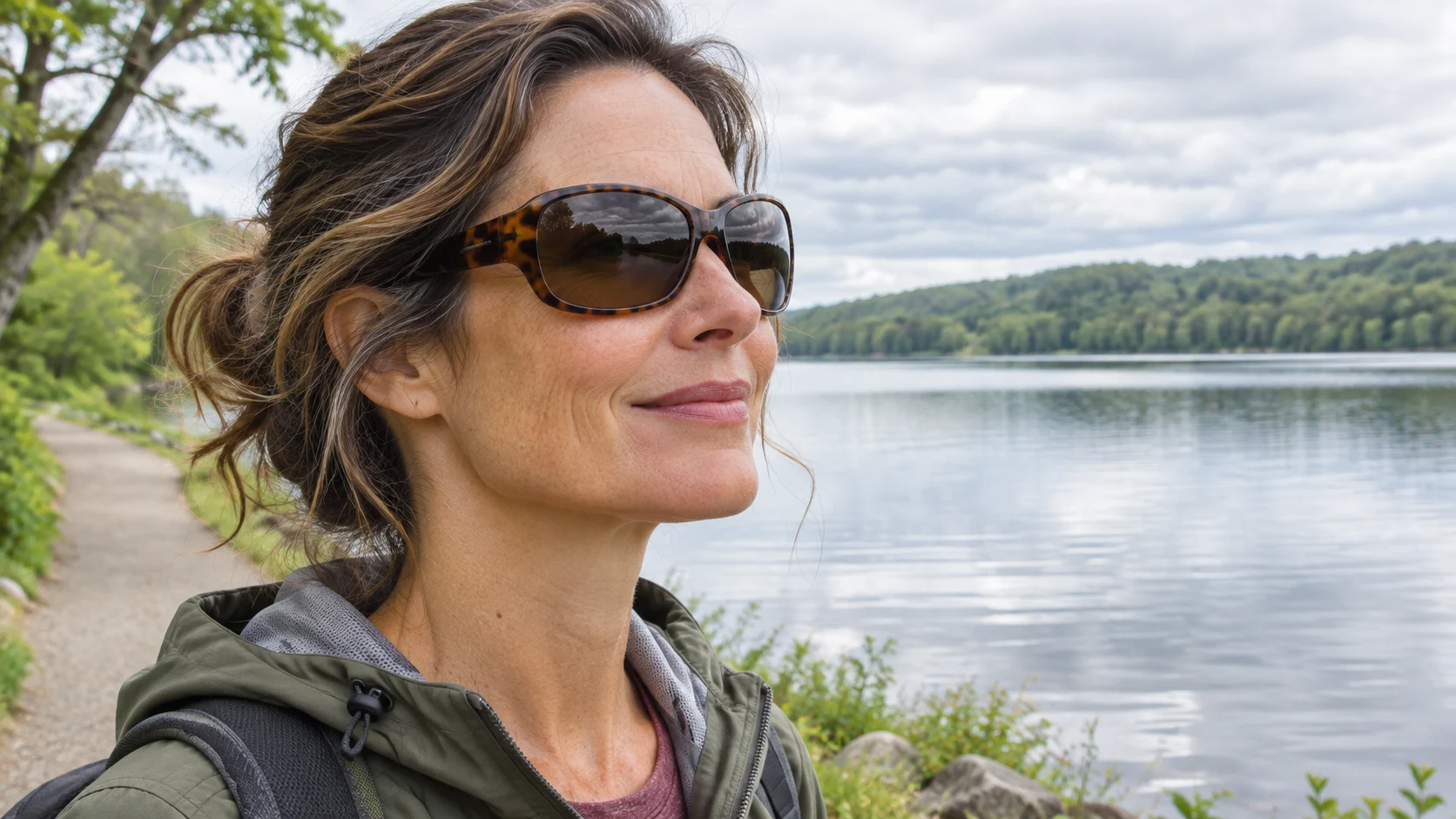
You’re choosing between two pairs of sunglasses. One has nearly black lenses. The other has a lighter tint and a small sticker that says “UV400.” Which detail tells you more about eye protection? Start with the sticker. Then try the glasses on and look at how much space there is between the frames and your face.
What should the UV label say?
Look for UV400 or a statement that the lenses block 99–100% of both UVA and UVB rays. UV400 means the lenses are designed to filter ultraviolet wavelengths up to 400 nanometers. A dark tint tells you how much visible light passes through. Even a light-colored lens can offer full UV protection.
An inexpensive pair with the right protection and a good fit can serve you well. If your favorite pair has lost its label and you’re unsure what it filters, ask an optical shop whether it can test the lenses. Holding them up to a bright light won’t answer that question.
Do you need sunglasses when it’s cloudy?
On a gray morning, the light can feel comfortable while ultraviolet rays still reach your eyes. The amount varies with cloud cover, elevation and the angle of the sun. Check the UV Index in your weather app. The World Health Organization recommends sun protection when the index reaches 3. The index describes the potential for skin damage. It doesn’t measure the light reaching your eyes from the side or reflecting off the ground.
Think of a ski trail: fresh snow reflects UV upward, and exposure increases at higher elevations. Water and pale sand can also reflect light toward your face. Close-fitting sunglasses or UV-protective ski goggles help cover the angles a brimmed hat leaves open. Long-term UV exposure can contribute to cataracts. An intense exposure, such as a day on snow without eye protection, can injure the cornea and cause pain and light sensitivity. Seek prompt eye care if you develop significant eye pain or a change in vision.
What does polarization add?
If you’ve ever struggled to see past the shimmer on a lake or glare from a wet road, that’s where polarization helps. Polarized lenses reduce reflected glare. Check the UV label separately, even if the lenses are polarized or mirrored. Once you’ve confirmed the UV rating, choose a tint that feels comfortable and lets you see the details you need.
If you drive, try the glasses in your parked car. Can you read the dashboard and navigation screen from your usual seat? Polarization can make some displays difficult to read. Choose a driving-appropriate tint and take the glasses off when daylight fades.
How can you tell if the frames fit?
Look straight ahead in a mirror, then turn your head to the side. A small, flat lens can leave a wide gap at your temple. Larger lenses that sit close to your face, or frames that curve around the sides, offer more coverage. Lean forward as if tying a shoe and check whether they slide. For children, look for the same UV rating, impact-resistant lenses and a frame that stays put during play. Activities with flying balls or debris call for sport-specific or safety eyewear.
What if you wear prescription glasses or contacts?
Clear prescription lenses can filter UV, depending on their material and coatings. Your optician can check the specifications. If glare is the main nuisance and you want to keep your current glasses, try a UV-rated fit-over pair or clip-on and check the coverage at the sides. Prescription sunglasses are another option. Many photochromic lenses, which darken outdoors, stay relatively light inside a car because the windshield filters much of the UV that activates them.
UV-blocking contact lenses leave parts of the eye and the eyelids exposed, so wear sunglasses over them outdoors. After cataract surgery, sunglasses can help with outdoor glare and protect the tissues around the eye. Follow your surgeon’s advice during recovery.
One important exception is looking directly at the sun. Even very dark UV400 sunglasses are unsafe for viewing a solar eclipse. That requires a special-purpose solar viewer that meets the ISO 12312-2 standard. For an ordinary walk or drive, the shopping decision is simpler: check the UV rating, try the fit and choose the tint for the light you’ll actually be in.
Read the sources
- World Health Organization (WHO). Ultraviolet Radiation. Information about UV radiation, health effects, and protective measures.
- World Health Organization (WHO). Radiation: Ultraviolet (UV) Radiation. Factors affecting UV exposure, including clouds, altitude, water, and snow.
- American Academy of Ophthalmology (AAO). How to Choose the Best Sunglasses to Avoid Sun Damage. Guidance on UV protection, lens darkness, polarization, size, and quality.
- American Academy of Ophthalmology (AAO). Recommended Types of Sunglasses. Information about polarized, photochromic, mirrored, and other lens types.
- National Eye Institute (NEI). Protecting Your Eyes from the Sun's UV Light. Information on UV400 protection, lens materials, eye safety, and sunglasses selection.
- U.S. Food and Drug Administration (FDA). Ultraviolet (UV) Radiation. Information about the UV Index and factors affecting UV exposure.
- U.S. Food and Drug Administration (FDA). Guidance Document for Nonprescription Sunglasses. Regulatory guidance concerning sunglasses, quality, labeling, and safety considerations.
- American Academy of Ophthalmology (AAO). Being EyeSmart in the Sun. Eye protection recommendations for children and adults.
- Government of Canada. UV Index and Sun Safety. UV Index categories and sun-protection recommendations.
This article explains selected evidence. It is not a systematic review or individual medical advice.