Can what we put on the table for breakfast, lunch and dinner today make a difference to our memory ten or twenty years from now? Researchers have followed people’s eating habits for decades to try to answer that question. What stands out is a pattern of meals, rather than a single food.
Alzheimer’s disease is the most common cause of dementia. Over time it affects memory, thinking and the ability to manage everyday tasks. Age and genetics play important roles. Researchers are also looking at factors we have some influence over, including what we eat, how much we move and how we look after our blood vessels.
In several long-term studies, people who ate more vegetables, fruit, whole grains, beans, fish and unsaturated fats tended to have better cognitive outcomes. That is a good reason to look more closely at these foods. It is not a guarantee that a particular breakfast will protect anyone from Alzheimer’s.
The Mediterranean diet: why heart health matters to the brain
Mediterranean-style eating starts with vegetables, fruit, beans, whole grains, nuts and olive oil. Fish makes a regular appearance; red meat and foods high in saturated fat play a smaller part. You do not have to cook Mediterranean recipes to eat this way.
What does the heart have to do with memory? The brain relies on a steady supply of oxygen and nutrients carried by the blood. High blood pressure, diabetes and damage to blood vessels can affect how well the brain works. Meals that help manage blood pressure, cholesterol and blood sugar can support the vessels the brain depends on.
This way of eating also supplies fiber, unsaturated fats and many different plant compounds. Researchers are studying how those compounds affect inflammation and oxidative stress. Understanding a possible mechanism is useful, but it does not by itself tell us whether a food prevents disease.
What is the MIND diet?
The MIND diet combines features of Mediterranean eating with DASH, an eating plan originally developed to help lower high blood pressure. MIND puts particular emphasis on leafy greens and berries, alongside other vegetables, nuts, beans, whole grains, fish, poultry and olive oil. It leaves less room for butter, high-fat cheeses, red meat, fried fast food and pastries.
In observational studies, people whose meals more closely resembled this pattern often experienced slower cognitive decline. A randomized trial asked a different question: if people are assigned to follow MIND, do they do better on cognitive tests? Researchers followed 604 older adults without cognitive impairment who had a family history of dementia. Both groups received counseling and aimed for a modest reduction in calories; only one group was assigned the MIND diet.
After three years, cognitive scores had improved in both groups. The difference between them was not statistically significant. That trial did not show that MIND was superior to the comparison diet for cognition, and it was not a test of whether the diet prevents an Alzheimer’s diagnosis. You can use the menu ideas without treating them as a prescription for memory loss.
Which foods are worth putting on the menu?
Leafy greens
Spinach, kale, arugula and lettuce provide folate, vitamin K and carotenoids. You do not have to work your way through a large salad every day. Wilt a handful of spinach into an omelet, stir greens into soup just before serving, or tuck a few leaves into a sandwich.
Berries
Blueberries, strawberries, raspberries and blackberries contain plant compounds called polyphenols. Among them are anthocyanins, the pigments behind many of the berries’ red, blue and purple colors. Some studies have linked eating berries regularly with better cognitive outcomes; they have not established that berries prevent dementia. Frozen berries are a practical option: stir them into warm oatmeal or spoon them over plain yogurt.
Fish and omega-3 fats
Salmon, sardines, mackerel and herring provide omega-3 fats, including DHA, a component of nerve cell membranes. Fish features in both Mediterranean and MIND eating patterns. Eating fish in place of another main course is a different intervention from adding a fish oil capsule to the same dinner. Omega-3 supplements have not been shown to prevent Alzheimer’s in healthy adults.
Nuts and olive oil
Walnuts, almonds and other nuts provide unsaturated fats, fiber and minerals. Olive oil is another source of unsaturated fat. Think about where you might make a swap: dress vegetables with olive oil in place of a buttery sauce, for example. A small handful of nuts can be a satisfying snack if you enjoy them and have no nut allergy.
Beans and whole grains
Beans, lentils, peas, oats, buckwheat and whole-grain bread provide fiber; beans and lentils also make an easy source of plant protein. A bowl of lentil soup or oatmeal can keep a meal filling while supporting blood sugar and cholesterol management. That matters because diabetes and cardiovascular risk factors are also linked to dementia risk.
Which foods should we eat less often?
Consider what the new food replaces. Adding beans to a stew may mean using less sausage. Serving fish for dinner one night leaves room for red meat on another. Limiting processed meat such as bacon and hot dogs does not require giving up every food you like.
Sugary drinks, chips, sweets and deep-fried foods are better kept from becoming the basis of everyday meals. But “processed” need not mean “unhealthy.” Frozen vegetables, canned beans and whole-grain bread can all help put a good dinner on the table. What a food contains, and what else is on your plate, tells you more than the fact that it came in a package.
What might a day of eating look like?
Breakfast: Oatmeal with blueberries, a few walnuts and plain yogurt. Frozen berries can go straight into the hot oats.
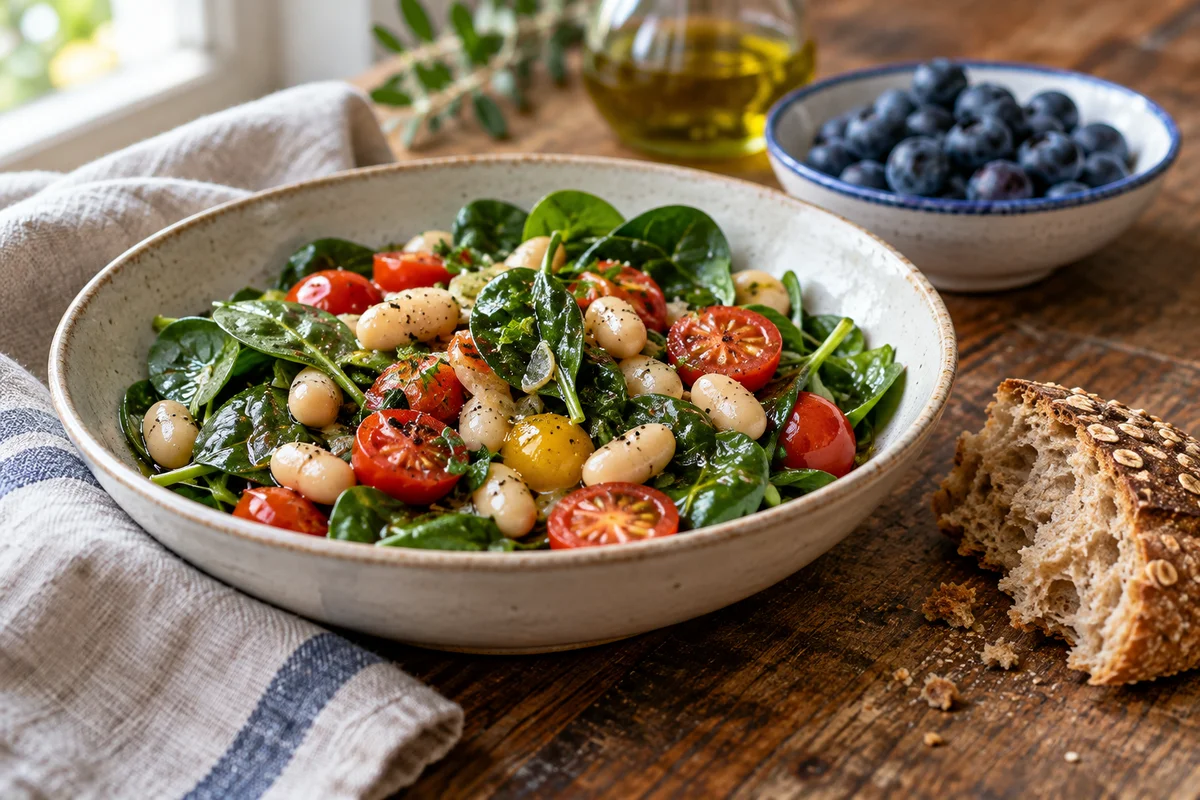
Lunch: Spinach, white beans and tomatoes tossed with olive oil, with whole-grain bread on the side. Add chicken or fish if you like.
Dinner: Baked salmon with buckwheat or brown rice and steamed vegetables. If you are hungry between meals, try a piece of fruit or a small handful of nuts.
This is one example, not a therapeutic menu or a test you have to pass. If breakfast already works for you, keep it. Lunch may be the easier place to start.
Can diet prevent Alzheimer’s disease?
We do not have evidence that any diet reliably prevents Alzheimer’s. Long-term studies can spot associations a short trial might miss. For instance, a 2026 analysis of two large U.S. cohorts found that people who more consistently followed Mediterranean or MIND patterns had a lower risk of dementia. Dementia from any cause, however, is not the same outcome as Alzheimer’s disease specifically.
People who eat this way may also exercise more, smoke less or have better access to care. Researchers try to account for these differences, but cannot separate them completely. The practical reason to adopt some of these habits is that they support overall and cardiovascular health, even while the size of any direct benefit for memory remains uncertain.
There is more to brain health than food
Walking, swimming, cycling and strength exercises help maintain cardiovascular fitness, muscle strength and metabolic health. Blood pressure, cholesterol and diabetes deserve attention, too. Smoking, heavy drinking, hearing and vision loss, depression and social isolation are among the other factors linked with dementia risk.
In the two-year U.S. POINTER randomized trial, more than 2,100 older adults at increased risk of cognitive decline took part in one of two lifestyle programs. Both encouraged healthier eating, movement, social and mental activity, and attention to heart health. The more structured group had regular support and accountability; the other pursued changes with less guidance.
Both groups improved on cognitive testing. The structured group improved slightly more. Because the program changed several things at once, the result cannot be credited to the diet alone. Nor does the finding establish that either program prevented Alzheimer’s disease.
When should you start thinking about memory?
Many of us first take an interest when we or someone close to us begins to forget things. There are good reasons to look after vascular health in our 40s and 50s, years before that first concern. But starting in your 70s is not too late to enjoy more nourishing meals, move more comfortably or improve management of a chronic condition.
An occasional lapse is not necessarily a sign of Alzheimer’s. Poor sleep, stress, depression, medications and other treatable conditions can affect memory. If changes are becoming more frequent or getting in the way of daily life, talk with your primary care doctor rather than waiting to see whether a change in diet fixes them.
One change you can keep
You do not need a specialty grocery store or an expensive “brain food.” Put frozen berries beside the oats, keep a can of beans for soup, or choose a fish dinner you would look forward to eating again. Those small decisions are easier to repeat when they fit your taste, budget and routine.
No single food can promise that your memory will stay the same. What you can choose is your next meal, a walk you enjoy, and time to look after your sleep and blood pressure. Each has value in its own right.
Read the sources
- National Institutes of Health. Healthful diet linked to reduced risk of cognitive decline (2024).
- Barnes LL, et al. Trial of the MIND Diet for Prevention of Cognitive Decline in Older Persons. New England Journal of Medicine (2023).
- Liu Y, et al. Long-term adherence and changes in the Mediterranean and MIND diets in relation to dementia risk and cognitive function. Alzheimer’s & Dementia (2026).
- Livingston G, et al. Dementia prevention, intervention, and care: 2024 report of the Lancet standing Commission. The Lancet (2024).
- Baker LD, et al. Structured vs Self-Guided Multidomain Lifestyle Interventions for Global Cognitive Function: The US POINTER Randomized Clinical Trial. JAMA (2025).
- World Health Organization. Risk reduction of cognitive decline and dementia: recommendations on diet and other interventions.
- National Institute on Aging. What Do We Know About Diet and Prevention of Alzheimer’s Disease?
This article explains selected evidence. It is not a systematic review or individual medical advice.