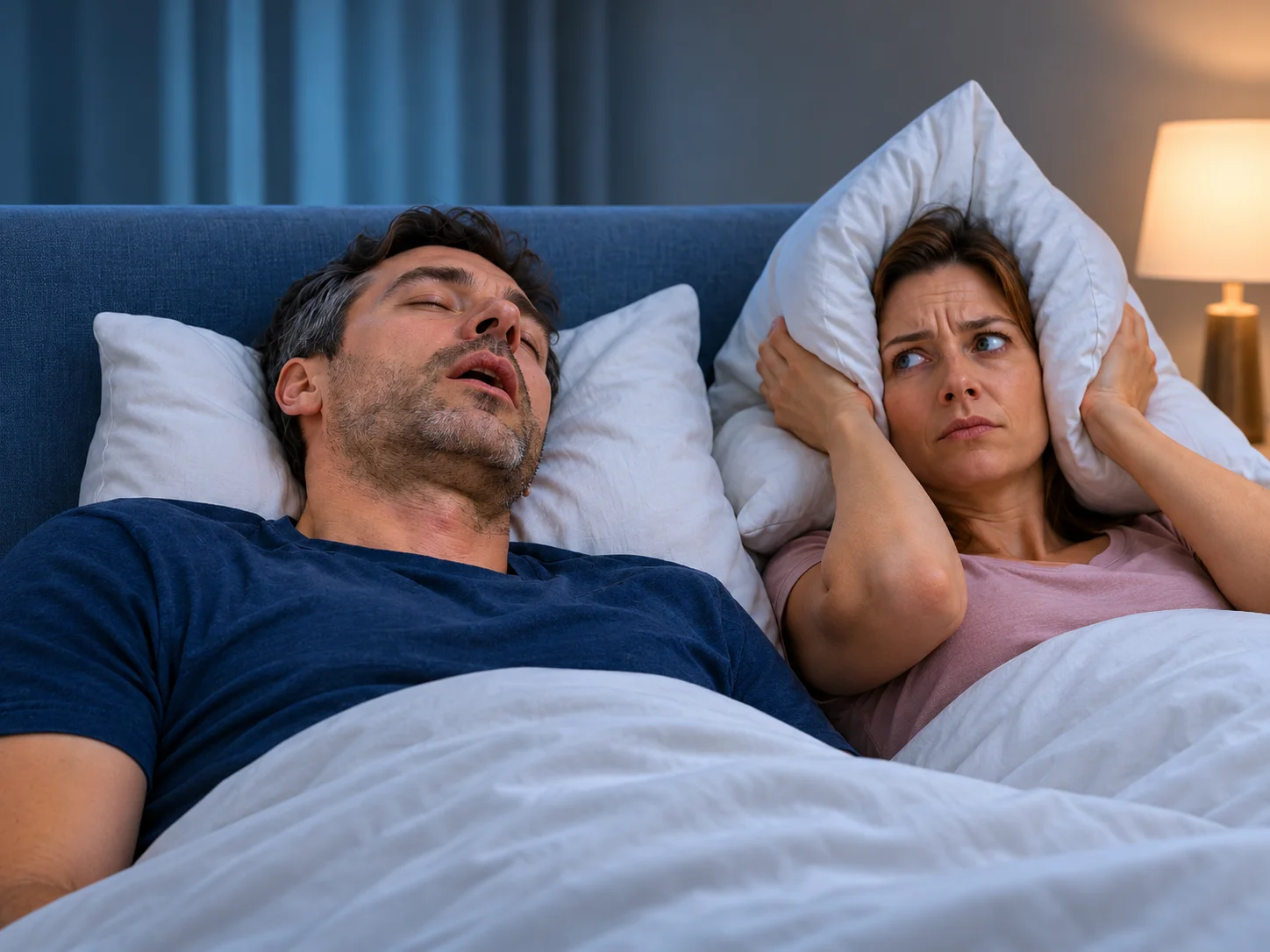
It’s the silence that wakes you. Your partner was snoring a moment ago. Now you’re listening for the next breath. It comes with a snort, your partner rolls over, and by morning you’re the only one who remembers it. If this keeps happening, that description is worth sharing with a primary care doctor. A pause followed by gasping tells the doctor more than how loudly someone snores.
What can a bed partner notice?
Snoring can disturb two people’s sleep. One may wake with a dry mouth or headache. The other may have spent half the night nudging a shoulder or moving to the couch. Talk about it during the day, when neither of you is trying to get back to sleep. “I heard you stop breathing several times and then gasp” gives your partner something specific to take to an appointment. Sleeping separately for a night may help the person who is being kept awake, but it won’t explain the change in breathing.
Why does snoring come and go?
As the muscles in the throat relax during sleep, the space that air passes through can narrow. Air flowing through that space makes soft tissue vibrate. A stuffy nose during a cold may explain an unusually noisy week. Sleeping on your back can allow the tongue and soft tissues to fall backward. Alcohol near bedtime can relax the airway further.
Jaw shape, enlarged tonsils, age and weight can all play a part. People of any body size can have obstructive sleep apnea (OSA). It occurs in women as well as men, and the risk rises after menopause. Someone who mainly describes fatigue, insomnia or frequent waking can be easy to overlook if no one asks about breathing.
When does snoring deserve a sleep evaluation?
With OSA, the upper airway repeatedly narrows or closes enough to reduce airflow. Oxygen levels may fall, and the brain briefly rouses the sleeper to reopen the airway. Many people remember none of those interruptions. The volume of a snore alone cannot tell you whether this is happening.
Ask your doctor about frequent loud snoring, especially if someone has witnessed breathing pauses, choking or gasping. Mention unrefreshing sleep, difficulty concentrating, high blood pressure or sleepiness during routine activities. Frequent nighttime urination can be part of the picture, too, although it has many other possible causes. If you feel sleepy at the wheel, stop somewhere safe and arrange another way to travel.
Children can have OSA as well. A child who snores regularly, breathes with effort or pauses during sleep should be assessed by a pediatrician. During the day, the clues may be hyperactivity or trouble paying attention. Enlarged tonsils or adenoids are common contributors.
What can you try tonight?
- Try sleeping on your side if the snoring is worse on your back. Notice whether the breathing pauses also persist and tell your doctor what you observe.
- Skip alcohol close to bedtime. If snoring began after a medicine change, ask the prescriber whether the medicine could contribute before changing how you take it.
- Address a persistently blocked nose. Tell your clinician whether congestion is seasonal, constant or limited to one side. Avoid taping your mouth shut, particularly if nasal breathing is difficult or sleep apnea is possible.
If excess weight is contributing, weight management can improve symptoms over time. You can pursue a sleep evaluation now, even if you also plan to lose weight. A quieter night after a change in sleep position does not establish that breathing has returned to normal.
How do you find out whether it’s sleep apnea?
A clinician will ask about sleep, daytime symptoms and other health conditions. An overnight laboratory sleep study records breathing, oxygen levels and sleep stages. A home sleep apnea test is an option for certain adults with symptoms suggesting moderate to severe OSA. Home testing measures fewer signals. If the result is negative, inconclusive or technically inadequate and OSA is suspected, the next step is a laboratory study. A phone recording can help describe what you heard but cannot diagnose or rule out OSA.
A sleep report may list an apnea-hypopnea index (AHI). This is the average number of breathing pauses and partial reductions in airflow per hour of sleep. Your clinician interprets it alongside oxygen levels, symptoms and medical history. Untreated OSA is associated with high blood pressure and cardiovascular disease. Daytime sleepiness can also affect safety at work and on the road.
What happens after a diagnosis?
Continuous positive airway pressure (CPAP) uses a mask and gentle air pressure to keep the airway open while you sleep. If leaks, dryness or an uncomfortable mask make it hard to use, tell the sleep team. A change in fit or humidification may help. A custom oral appliance that moves the lower jaw forward is an option for some people, particularly if they cannot tolerate CPAP or prefer an alternative. A sleep clinician and a dentist trained in these devices can arrange fitting and follow-up.
For adults who have both obesity and moderate to severe OSA, the FDA has also approved tirzepatide (Zepbound) alongside a reduced-calorie diet and increased physical activity. This prescription treatment has a specific indication. Ordinary snoring alone does not qualify. If symptoms improve after weight loss or another treatment, ask whether repeat testing is appropriate before stopping prescribed airway therapy.
When you make the appointment, take the detail you can actually observe: “It happens most nights, especially on my back,” or “My partner hears pauses and I struggle to stay awake after lunch.” That is enough to start the conversation.
Based on material by Madara Mičule. English adaptation by VitalMeGuide.
Read the sources
- National Heart, Lung, and Blood Institute (NHLBI). Sleep Apnea: Symptoms. Updated 2025.
- National Heart, Lung, and Blood Institute (NHLBI). Sleep Apnea and Women.
- Beninati, W., Harris, C. D., Herold, D. L., & Shepard, J. W. Jr. (1999). The Effect of Snoring and Obstructive Sleep Apnea on the Sleep Quality of Bed Partners. Mayo Clinic Proceedings, 74(10), 955–958.
- Cascais Costa, C., Afreixo, V., & Cravo, J. (2023). Impact of Obstructive Sleep Apnea Treatment on Marital Relationships: Sleeping Together Again? Cureus, 15(10), e46513.
- Marcus, C. L., et al. (2012). Diagnosis and Management of Childhood Obstructive Sleep Apnea Syndrome. Pediatrics, 130(3), 576–584.
- Benjafield, A. V., et al. (2019). Estimation of the Global Prevalence and Burden of Obstructive Sleep Apnoea: A Literature-Based Analysis. The Lancet Respiratory Medicine, 7(8), 687–698.
- Kapur, V. K., et al. (2017). Clinical Practice Guideline for Diagnostic Testing for Adult Obstructive Sleep Apnea. Journal of Clinical Sleep Medicine, 13(3), 479–504.
- Patil, S. P., et al. (2019). Treatment of Adult Obstructive Sleep Apnea With Positive Airway Pressure: An American Academy of Sleep Medicine Clinical Practice Guideline. Journal of Clinical Sleep Medicine, 15(2), 335–343.
- Ramar, K., et al. (2015). Clinical Practice Guideline for the Treatment of Obstructive Sleep Apnea and Snoring With Oral Appliance Therapy. Journal of Clinical Sleep Medicine, 11(7), 773–827.
- Sarkis, L. M., et al. (2023). Australasian Sleep Association Position Statement on Consensus and Evidence-Based Treatment for Primary Snoring. Respirology, 28(2), 110–119.
- U.S. Food and Drug Administration (FDA). (2024). FDA Approves First Medication for Obstructive Sleep Apnea. December 20, 2024.
- American Diabetes Association / Obesity Association. (2025). Pharmacologic Treatment of Obesity in Adults: Standards of Care in Overweight and Obesity.
This article explains selected evidence. It is not a systematic review or individual medical advice.