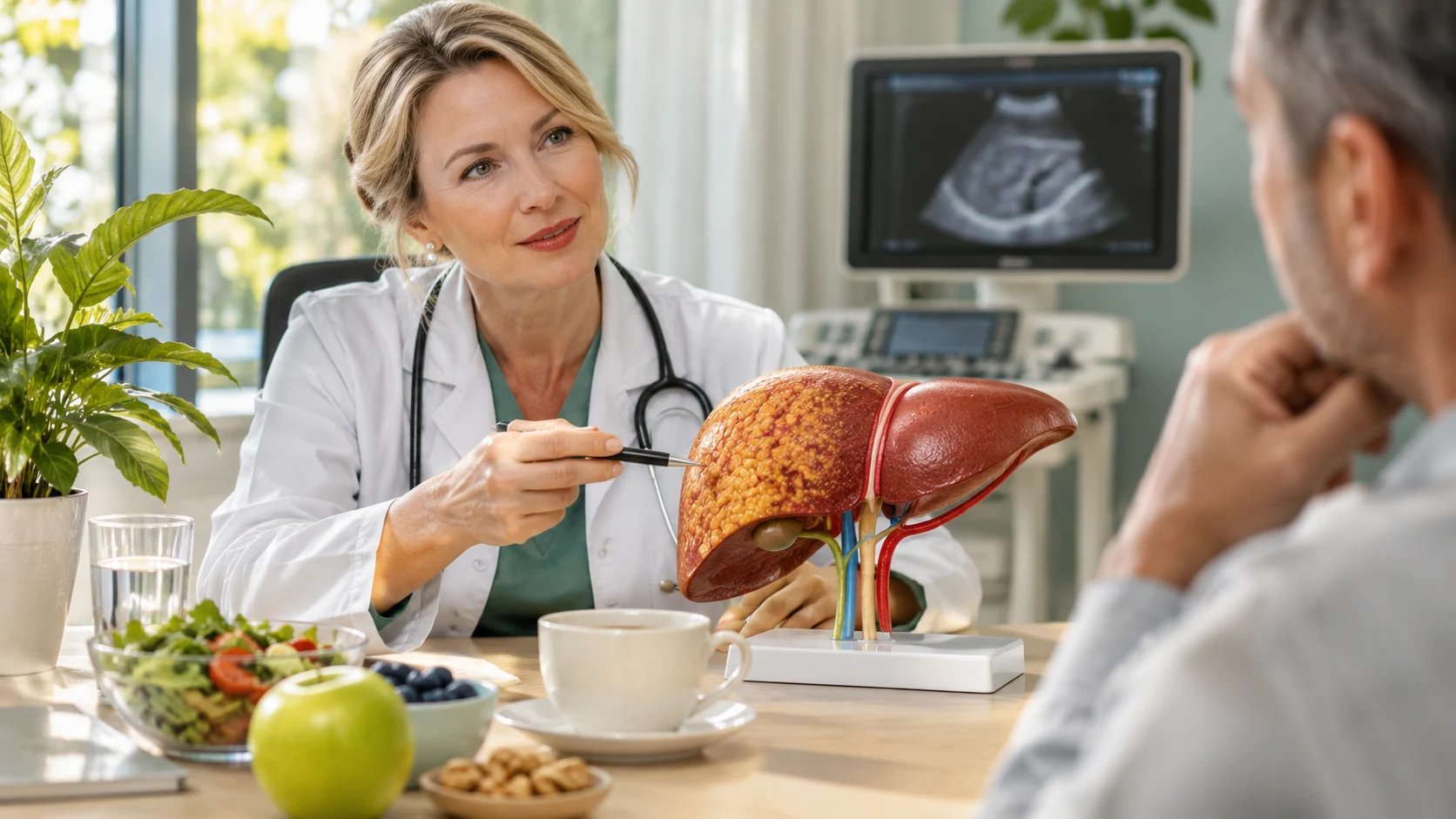
You went in for an ultrasound for something else. Now you’re looking at two unexpected words in the report: “fatty liver.” Nothing hurts. Your last blood tests looked fine. What do you do with that information?
VitalMeGuide puts readers’ questions to the medical explanations of hepatologist and infectious disease specialist Indra Zeltiņa, MD, PhD. The answers below include editorial updates from clinical guidelines and U.S. prescribing information.
What does my liver actually do?
Think about what happens after lunch. Your liver processes nutrients, stores some of that energy for later, and releases glucose between meals. It also makes bile to help you absorb fat and proteins that help your blood clot. Many of the medicines you take pass through it, too.
What does “fatty liver” mean on a scan?
It means fat has built up inside liver cells. When that finding comes with a metabolic risk factor, such as type 2 diabetes or high blood pressure, your doctor may use the term MASLD, short for metabolic dysfunction-associated steatotic liver disease. You might recognize the older term, NAFLD. Alcohol intake and other possible causes also matter when making a diagnosis.
Some people have fat in the liver with little injury. Others develop inflammation and liver cell damage, called MASH. As the liver tries to repair itself, scar tissue can form. The medical word for that scarring is fibrosis.
Can I have fatty liver disease at a healthy weight?
Yes. A bathroom scale can’t tell you how much fat is stored around your organs. People with similar builds can have quite different metabolic risks. Your family history, blood sugar, blood pressure and cholesterol give your doctor a fuller picture.
Wouldn’t I feel it if something were wrong?
Often, the first sign is the scan itself. Some people notice fatigue or a dull ache under the ribs on the right, but those symptoms have plenty of other possible causes. How well you feel tells you little about how much scarring there is.
My liver blood tests were normal. Is that reassuring?
It’s one piece of the picture. ALT and AST are enzymes that can rise when liver cells are injured. Both can fall within the lab’s normal range even in someone with significant scarring. If a scan has already shown fat, a useful follow-up question is, “Do we need to check my risk of fibrosis?”
How do you check for scarring?
Your doctor may already have the numbers for a first check. A calculation called FIB-4 uses your age, ALT, AST and platelet count to estimate the likelihood of advanced scarring. An unclear or elevated result can lead to a liver stiffness measurement or a specialist visit. Age matters when interpreting the score. It’s less reliable under 35, and doctors use a different cutoff after 65.
What is a FibroScan? Does it hurt?
You lie down while a clinician holds a probe against your right side. You may feel a light tap. The test is usually quick and painless. It measures how stiff the liver is, and it can also estimate liver fat. Scarring can make the liver stiffer, though inflammation and other conditions can affect the reading.
Didn’t my ultrasound already check that?
A standard ultrasound can pick up more pronounced fat accumulation and can miss milder changes. It can’t reliably tell how much early scarring there is or whether liver cells are inflamed. That’s why your doctor might suggest a second kind of scan even though you’ve just had one.
What happens if the disease progresses?
Many people never develop severe liver disease. In some, scar tissue gradually changes the structure of the liver. Advanced scarring, called cirrhosis, can lead to fluid buildup in the abdomen, internal bleeding or confusion. Liver cancer risk also rises, particularly with cirrhosis. Finding out how much scarring is present helps you and your doctor decide what follow-up you need.
Why did this happen to me?
Insulin resistance, type 2 diabetes, fat stored deep in the abdomen and inherited traits can all play a part. Several causes of liver injury can coexist. Expect questions about alcohol and medications, and possibly tests for hepatitis B or C. An ultrasound describes what the liver looks like. Working out why takes a little more detective work.
Can I still have a glass of wine?
Alcohol can add to liver injury in someone with MASLD. Tell your doctor what you drink in a typical week so you can discuss cutting back or avoiding it. If you have advanced fibrosis or cirrhosis, the recommendation is to avoid alcohol completely.
Could one of my medicines be responsible?
Some medicines can cause liver injury or fat buildup. Bring a list that includes prescriptions, over-the-counter products and supplements. Check with your prescriber before stopping anything. Statins, for example, are generally safe for people with MASLD and can be particularly valuable for reducing cardiovascular risk.
Can a fatty liver recover?
Yes. Liver fat can decrease, inflammation can settle, and some scarring can improve. Advanced cirrhosis is much harder to reverse and needs ongoing care. Even when scarring is established, treating the cause can help prevent further damage.
If weight loss would help me, how much makes a difference?
For people with MASLD who have overweight or obesity, European guidelines suggest aiming for sustained weight loss of at least 5% to reduce liver fat, 7–10% to improve inflammation, and at least 10% to improve scarring. These are treatment goals, and individual results vary. For someone weighing 220 pounds (100 kg), the first goal would be about 11 pounds (5 kg).
What would you change at the dinner table?
A Mediterranean-style pattern is a practical starting point: vegetables, beans, whole grains, fish, nuts and olive oil. Start with something you have often. If you usually have soda with lunch, try water or unsweetened tea. Whole fruit can stay on the menu. An apple gives you fiber and takes longer to eat than a sweet drink takes to finish.
What about my morning coffee?
If you enjoy coffee, there’s generally room for it. In observational studies, regular coffee drinkers have tended to have less advanced liver scarring. Some studies have seen similar associations with decaf. That doesn’t establish that coffee caused the difference, or that everyone needs three cups a day.
If caffeine leaves you jittery or keeps you awake, there’s no reason to push through for your liver’s sake. If your usual order comes with sweetened syrup, cutting back on the syrup is a simple change you can make while keeping the coffee.
Does walking help if the scale barely moves?
Yes. Regular activity can reduce liver fat and improve how your body responds to insulin even without much weight loss. A short walk after lunch is a reasonable place to start. As it gets easier, add a few minutes, pick up the pace or try cycling or swimming. Strength exercises help preserve muscle, too.
Are there medicines specifically for fatty liver disease?
In the U.S., resmetirom (Rezdiffra) and semaglutide (Wegovy) are options for certain adults with MASH, moderate to advanced fibrosis (stages F2–F3), and no cirrhosis. A report that simply says “fatty liver” doesn’t establish eligibility. Your clinician will consider the stage of disease, other conditions, and potential side effects alongside nutrition and activity.
Is that the same as taking Ozempic?
Ozempic and Wegovy both contain semaglutide, but they have different approved uses. The U.S. MASH indication applies to Wegovy. If you already take Ozempic for type 2 diabetes, tell your liver specialist. That lets your clinicians coordinate treatment and avoid doubling up on the same medicine.
Where does weight-loss surgery fit in?
For someone who meets the criteria for metabolic surgery, the benefits can include less liver fat and improvement in MASH or fibrosis. The decision depends on overall health and the stage of liver disease. Cirrhosis changes the surgical risks and calls for specialist assessment.
Should I buy a “liver protection” supplement?
There’s no convincing evidence that a liver cleanse reverses scarring. Milk thistle is often marketed for liver health, but it hasn’t shown a meaningful benefit for treating MASH. Some herbal products can themselves cause liver injury. If you already take one, bring the bottle or a photo of the label to your appointment.
What should I bring to my first liver appointment?
Take the ultrasound report, any recent liver tests and blood counts, and previous hepatitis test results if you have them. Bring your medication and supplement list. Be ready to describe a typical week of eating, activity and drinking. There’s no need to arrange a battery of tests yourself before the visit.
What’s the one question I should leave with?
“If my scan shows fat, what do we know about scarring, and when should we check again?” That question turns an unexpected finding into a plan. You leave knowing what your clinician will assess, what you can work on now, and when you’ll revisit it together.
Read the sources
- European Association for the Study of the Liver (EASL), European Association for the Study of Diabetes (EASD), and European Association for the Study of Obesity (EASO). (2024). Clinical Practice Guidelines on the Management of Metabolic Dysfunction-Associated Steatotic Liver Disease (MASLD). Journal of Hepatology.
- American Diabetes Association. (2026). Comprehensive Medical Evaluation and Assessment of Comorbidities: Standards of Care in Diabetes—2026. Diabetes Care.
- U.S. Food and Drug Administration (FDA). (2025). FDA Approves Treatment for Serious Liver Disease Known as MASH.
- U.S. Food and Drug Administration (FDA). (2024). FDA Approves First Treatment for Patients With Liver Scarring Due to Fatty Liver Disease.
- EASL, EASD & EASO. (2024). MASLD Clinical Practice Guidelines — Full Text.
- National Institute of Diabetes and Digestive and Kidney Diseases (NIDDK). Nonalcoholic Fatty Liver Disease and NASH: Diagnosis and Treatment.
- Rinella, M. E., et al. (2023). AASLD Practice Guidance on the Clinical Assessment and Management of Nonalcoholic Fatty Liver Disease. Hepatology.
This article explains selected evidence. It is not a systematic review or individual medical advice.