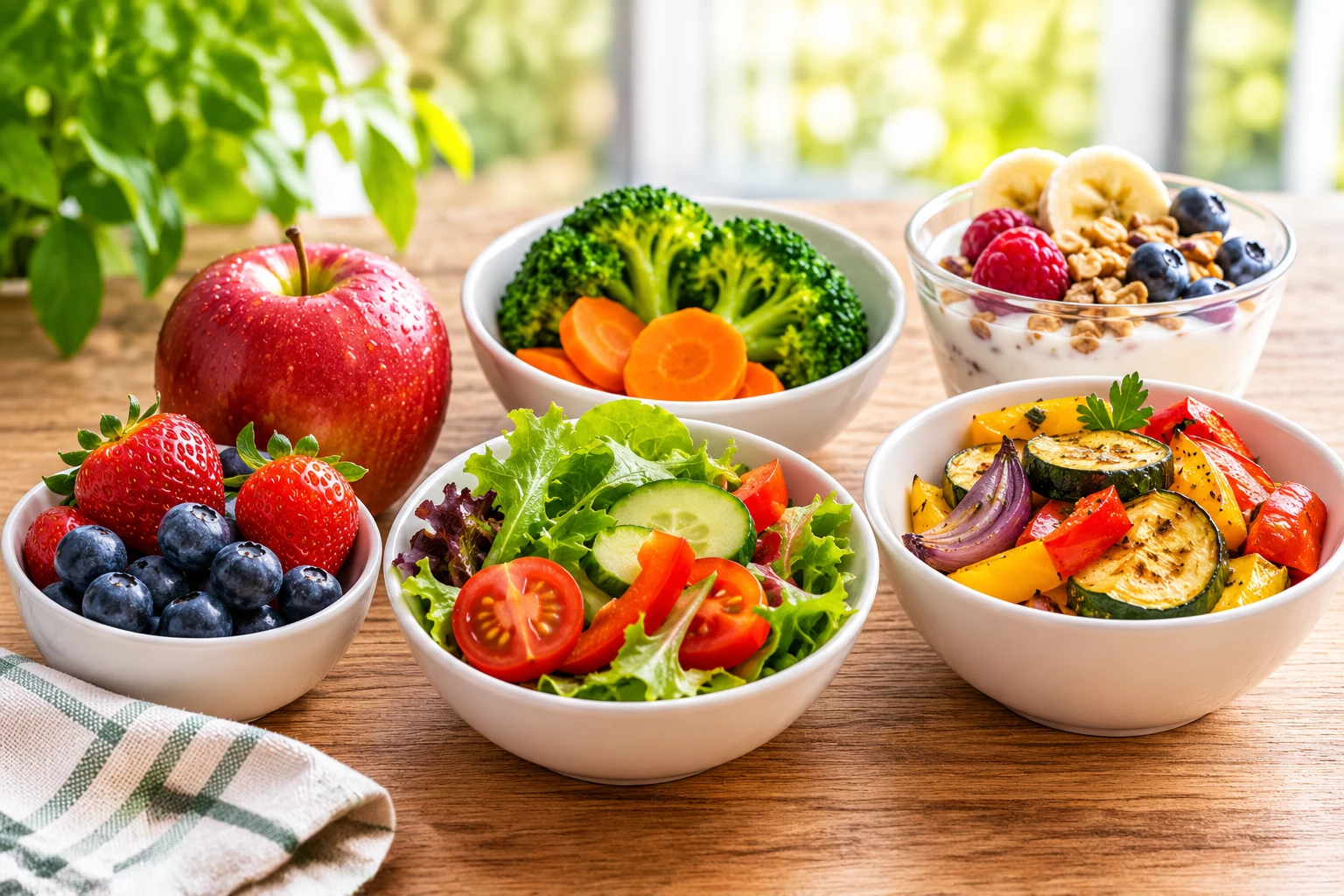
What’s the easiest meal in your day to add something to? If breakfast is always yogurt, try a handful of berries. If dinner is usually pasta, put frozen peas in the pot for the last few minutes. Starting with a meal you already make saves you from having to plan a whole new one.
What does “five a day” mean?
For adults, the World Health Organization recommends at least 400 grams of fruit and vegetables combined per day, about 14 ounces. Divide that across five portions and each averages 80 grams, just under 3 ounces. You can spread them across the day or eat several at the same meal.
American readers may know the USDA’s MyPlate illustration, which shows fruit and vegetables filling half a plate. The 2025–2030 Dietary Guidelines for Americans give a daily goal of three servings of vegetables and two of fruit for a 2,000-calorie eating pattern. Amounts vary with energy needs. A US serving and a British 80-gram portion are measured differently, so pick one guide to follow.
What does a portion look like on the plate?
The UK’s National Health Service gives these examples for one adult portion. Sizes vary, but they’re handy when you’re making lunch or packing a snack.
- One medium apple, pear or orange, or two small plums.
- About seven strawberries or 14 cherries.
- One medium tomato or about seven cherry tomatoes.
- Three heaping tablespoons of cooked carrots or peas.
- About an ounce (30 grams) of dried fruit. Drying removes water, so the portion is smaller. Try raisins in oatmeal or dried apricots with lunch.
Why mix vegetables and fruit?
If apples are the fruit you enjoy, keep buying them. For variety, look at what you could add elsewhere: carrots bring beta-carotene, leafy greens supply folate, and bell peppers are rich in vitamin C. Fruit and vegetables also contribute fiber.
In a large review of prospective studies, people who ate more fruit and vegetables tended to have lower rates of heart disease, stroke and premature death. The researchers followed people’s usual diets. Other differences, such as smoking and physical activity, may explain part of those associations.
Do potatoes, beans and vegetable soup count?
The answer for potatoes depends on the guide. MyPlate includes potatoes among starchy vegetables. The British five-a-day guide treats regular potatoes as a starchy staple and leaves them out of its five portions. Either way, a baked potato makes an easy base for broccoli or a side of green beans.
Beans, chickpeas and lentils provide both fiber and protein. In the British system they count once per day toward the five, however much you eat. In MyPlate they can contribute to the vegetable group or the protein group. In a bowl of lentil soup, the carrots, tomatoes and spinach count too. What matters is how much of each vegetable actually makes it into your bowl.
What if fresh produce spoils before I use it?
Buy fresh versions of the foods you finish and keep the rest frozen or canned. Plain frozen broccoli can go straight into a stir-fry. Canned tomatoes can become a sauce while the pasta cooks. If you usually throw away half a bag of fresh spinach, frozen spinach lets you use just enough for tonight’s soup.
For canned vegetables and beans, compare sodium per serving or look for “no salt added.” For canned fruit, look for fruit packed in water or its own juice. Plain frozen berries work well in yogurt without a sweetened sauce.
What about fruit sugar, juice and smoothies?
A whole orange gives you fiber along with its natural sugars. Most people can enjoy whole fruit regularly. If you count carbohydrates for diabetes, include the fruit portion in your count. Juice is easier to drink quickly and usually contains much less fiber. A smoothie made with whole fruit keeps more fiber, though a large glass can hold several pieces of fruit.
Under the British five-a-day guide, juice and smoothies together count as at most one daily portion: 150 milliliters, or about 5 US fluid ounces. For your teeth, have them with a meal instead of sipping them throughout the day.
How could five portions fit into an ordinary day?
- Breakfast: Add seven strawberries, fresh or thawed, to plain yogurt.
- Lunch: Slice a medium tomato into a sandwich and add an apple to your lunch bag. That brings the running total to three.
- Dinner: Serve three heaping tablespoons each of cooked carrots and peas alongside the rest of your meal. That makes five using the British portion examples.
If you usually eat very little fiber, start with one extra portion and build up gradually, especially with beans and lentils. If you’ve been prescribed a potassium restriction or a special diet for a digestive condition, your dietitian can help you choose portions and foods that fit.
For your next grocery trip, choose one thing you’ll eat fresh and one that will still be there on a busy evening. An apple in your lunch bag and a bag of peas in the freezer each solve a different part of the same problem.
Read the sources
- World Health Organization (WHO). Healthy Diet. Guidance on fruit and vegetable intake, dietary fiber, and healthy eating patterns.
- U.S. Department of Agriculture (USDA). MyPlate. American dietary guidance on fruit and vegetable intake, personalized serving goals, and healthy meal planning.
- National Health Service (NHS). 5 A Day: What Counts? Guidance on fresh, frozen, canned and dried produce, legumes, juices, and smoothies.
- National Health Service (NHS). 5 A Day Portion Sizes. Practical examples of fruit and vegetable portions.
- Aune, D., et al. (2017). Fruit and Vegetable Intake and the Risk of Cardiovascular Disease, Total Cancer and All-Cause Mortality: A Systematic Review and Dose-Response Meta-analysis of Prospective Studies. International Journal of Epidemiology, 46(3), 1029–1056.
- National Health Service (NHS). Eating a Balanced Diet. Recommendations for a varied, balanced eating pattern.
- Dietary Guidelines for Americans, 2025–2030.
This article explains selected evidence. It is not a systematic review or individual medical advice.