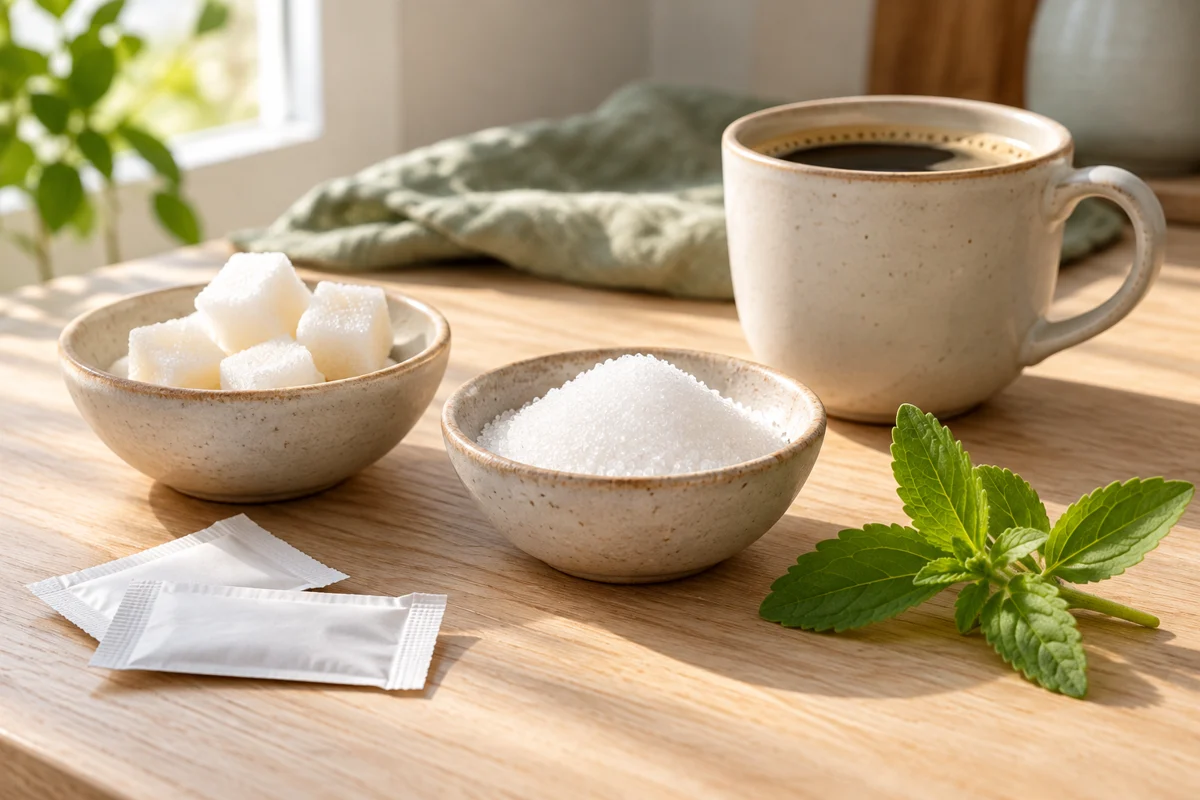
Sugar substitutes have become increasingly popular in recent years. They are used not only by people with diabetes, but also by those who want to cut back on sugar, manage their weight, or simply eat more healthfully.
Their popularity has brought plenty of questions. Are sweeteners really better than regular sugar? Can they affect the gut microbiome? And is there any reason to use them if you do not have a health condition?
To understand their benefits and possible risks, it helps to start with what happens in the body when we eat ordinary sugar.
What does regular sugar do in the body?
During digestion, ordinary table sugar, or sucrose, is broken down into equal parts glucose and fructose.
Glucose enters the bloodstream, raising blood glucose levels. This signals the body to help move glucose into cells, where it can be used.
Insulin, a hormone released by the pancreas, plays an important role. Think of it as a key that helps glucose enter muscle and fat cells to be used for energy or stored for later.
Some glucose is stored as glycogen in the liver and muscles. As blood glucose levels fall, insulin release usually decreases too.
When the body consistently receives more energy than it uses, the surplus can contribute to fat accumulation. Under certain metabolic conditions, carbohydrates can also be converted into fat.
Where does the problem begin?
Eating sweet foods and drinking sugary beverages too often or in large amounts can contribute to excess calorie intake and weight gain.
Excess body weight, particularly fat around the abdomen, is an important risk factor for insulin resistance.
Insulin resistance means that the body's cells respond less effectively to insulin. The pancreas then needs to release more insulin to help keep blood glucose within a normal range. Over time, if it cannot keep up, blood glucose can rise and type 2 diabetes may develop.
Insulin resistance is also associated with cardiovascular and other metabolic health problems.
Of course, sugar alone does not explain insulin resistance. Genetics, physical activity, body weight, and overall eating habits also matter.
In diabetes, the body either does not produce enough insulin or cannot use it effectively. Blood glucose can therefore rise substantially after eating foods containing sugar and other carbohydrates.
People without diabetes do not need to eliminate every food that contains sugar. People with diabetes can also include some sugar within an individualized eating plan. In diabetes, paying attention to total carbohydrate intake is especially important.
This is one situation in which sugar substitutes may be useful.
What kinds of sugar substitutes are there?
Sugar substitutes are not one uniform group. They differ in their origin, sweetness, calorie content, and effects on blood glucose.
Two common groups are sugar alcohols, also called polyols, and high-intensity sweeteners. The latter include both plant-derived and synthetic sweeteners.
Sugar alcohols, or polyols
This group includes:
- Xylitol
- Erythritol
- Sorbitol
- Maltitol
Some occur naturally in small amounts, but those used in food manufacturing are generally produced commercially. Despite the name, sugar alcohols are not the alcohol found in alcoholic drinks.
They generally provide fewer calories than table sugar, although the amount varies. Erythritol provides very few calories.
Most polyols raise blood glucose less than sucrose does, but that does not mean they all have no effect. Maltitol, for example, can have a greater effect on blood glucose than erythritol.
Large amounts of sugar alcohols can also cause bloating, abdominal discomfort, and diarrhea. Individual tolerance varies.
Plant-derived high-intensity sweeteners
One of the best-known examples is stevia. More precisely, food sweeteners use steviol glycosides, the sweet compounds associated with the stevia plant.
They are much sweeter than table sugar, so only small amounts are needed. They add little or no meaningful energy at those amounts and generally do not substantially raise blood glucose.
In the United States, the permitted uses concern certain highly purified steviol glycosides, rather than whole stevia leaves or crude extracts. Monk fruit extract is another popular option.
Check the ingredient list: products sold as “stevia” or “monk fruit” often contain other ingredients, including erythritol, to add bulk.
Artificial sugar substitutes
These include chemically synthesized sweeteners such as:
- Aspartame
- Sucralose
- Saccharin
- Acesulfame potassium, also called Ace-K
- Neotame
Some are hundreds of times sweeter than sucrose; others are thousands of times sweeter. Consequently, manufacturers use very small amounts.
Most high-intensity sweeteners do not directly raise blood glucose substantially at the amounts used in food. However, the food containing them may still contain carbohydrates that do.
These sweeteners appear in products such as cookies, yogurt, soft drinks, ice cream, and other desserts. They are also sold for home use.
Erythritol and stevia blends, for example, may be used in cooking, while sucralose- or saccharin-based tabletop sweeteners can be added to coffee or tea.
Are sugar substitutes safe?
This question continues to generate debate.
On one hand, permitted sweeteners have undergone safety evaluations. For approved high-intensity sweetener food additives, the U.S. Food and Drug Administration (FDA) has established acceptable daily intakes. Certain purified stevia and monk fruit ingredients follow the generally recognized as safe, or GRAS, pathway rather than food-additive approval.
The FDA considers approved high-intensity sweeteners safe for the general population under their approved conditions of use. An important exception is aspartame for people with phenylketonuria (PKU), who need to avoid or restrict it because it contains phenylalanine.
On the other hand, researchers continue to study how regular sweetener use may affect metabolism, the gut microbiome, and other aspects of health over the long term.
Two questions need to be kept separate: Is a sweetener safe at a particular intake? And does using it regularly improve long-term health?
These are not the same thing.
In 2023, the World Health Organization issued a conditional recommendation against using non-sugar sweeteners for long-term weight control or to reduce the risk of chronic noncommunicable diseases. Uncertainty in the evidence, including possible confounding in observational studies, is part of the reason the recommendation is conditional.
It does not apply to people with existing diabetes, whose disease management was outside the guideline's scope. It also does not cover sugar alcohols such as erythritol and xylitol, and it is not a reassessment of individual sweeteners' toxicological safety.
Research has also raised questions about erythritol and xylitol. Studies published in 2023 and 2024 linked higher blood levels to cardiovascular events and included experiments examining blood-clotting mechanisms. However, blood levels are influenced by the body's own production as well as intake, and these findings do not establish that ordinary dietary use causes heart attacks or strokes. Longer-term studies of consumption are needed.
Sugar substitutes can therefore be useful in some situations, but they do not automatically make a diet healthy.
How do sweeteners affect the gut microbiome?
This question has attracted particular scientific attention in recent years.
The gut microbiome includes the microorganisms living in the digestive tract, such as bacteria, fungi, and viruses, along with their genetic material and activities. It plays a role in processing fiber, producing various compounds, interacting with the immune system, and other bodily functions.
These microorganisms respond to what we eat. Fiber from vegetables, fruit, legumes, and whole grains provides food for some gut bacteria.
The effects of sweeteners are more complicated. Some studies suggest that certain artificial sweeteners can alter the microbiome and, under particular conditions, affect the body's response to glucose.
For example, a randomized study published in 2022 involved 120 healthy adults who were not habitual users of non-nutritive sweeteners. Researchers compared saccharin, sucralose, aspartame, and stevia with two control groups over a two-week supplementation period.
They found differing changes in the microbiome. The saccharin and sucralose groups also showed less favorable glucose responses.
However, this was a short study with 20 people in each group. It does not show that every sweetener harms gut bacteria in the same way, or that these changes necessarily lead to diabetes or other long-term illness.
Research is continuing. There is not yet enough evidence to determine precisely what these changes mean for long-term health.
When are sugar substitutes genuinely useful?
In her work with patients, nutrition specialist Eva Šmite finds that sugar substitutes can be a practical option for some people.
A child or adult with diabetes may find it difficult to give up sweet tastes completely. A dessert made with an appropriate sugar substitute can sometimes be an alternative to a conventional sweet treat, within the person's diabetes eating plan.
It can provide sweetness with less added sugar and, depending on the product, a smaller rise in blood glucose after eating. For children with diabetes, these choices should be made with their diabetes care team rather than treated as a general recommendation to use sweeteners routinely.
The overall composition of the product still matters.
“Sugar-free” does not mean carbohydrate-free or calorie-free. Sugar-free chocolate, for example, may still contain substantial amounts of fat and other energy-containing ingredients.
Read the serving size, total carbohydrate, and calories on the Nutrition Facts label, not just the wording on the front of the package. If you use insulin, ask your diabetes care team how to account for products containing sugar alcohols.
People without health conditions can use sugar substitutes too. But if their diet is balanced and sugar intake is not excessive, there may be no particular reason to replace ordinary sugar with a sweetener.
It is more useful to reduce excessive consumption of sweets and sugary drinks overall. Water and unsweetened drinks are straightforward everyday options.
Xylitol: a sugar substitute that may help your teeth
Some sugar substitutes have additional practical advantages.
Xylitol can be produced from plant-based materials, including birch wood and corn-processing products. It is a sugar alcohol with a sweetness similar to table sugar.
Unlike sucrose, it does not promote tooth decay in the same way. Oral bacteria cannot use it to produce acids as readily as they use ordinary sugar.
This is why xylitol is often used in sugar-free gum and mints.
Researchers have also studied whether xylitol provides additional protection against cavities, but the evidence is not conclusive. Chewing sugar-free gum can stimulate saliva, which itself helps protect teeth; any benefit should not automatically be attributed to xylitol alone.
Xylitol does not replace brushing with fluoride toothpaste, cleaning between teeth, or regular dental visits. Possible dental benefits also do not settle the separate questions about long-term cardiovascular effects discussed above.
One more practical point: xylitol is highly toxic to dogs. Keep products containing it out of their reach. If a dog may have swallowed xylitol, contact a veterinarian immediately.
How can you use sugar substitutes at home?
Be prepared for the taste of a food or drink to change. Stevia-based sweeteners, for example, can have a distinctive, slightly bitter aftertaste. Some people do not mind it; others find it unpleasant.
There is room to experiment. You might try a different sweetener, adjust the amount, or use a blend.
Remember, though, that sweetness varies considerably. Some sugar alcohols are less sweet than sucrose, whereas high-intensity sweeteners may be hundreds of times sweeter.
You cannot always use a sugar substitute in the same quantity as table sugar. Follow the manufacturer's directions, especially for concentrated products.
Can you simply replace sugar with a sweetener when baking?
Not always.
Table sugar does more than add sweetness. It helps create structure, affects moisture retention and browning, and, in certain preparations, acts as a preservative.
In jam, for example, sugar helps determine consistency and storage properties. In cookies and cakes, it affects texture and color.
Sugar substitutes do not necessarily perform these same functions. Replacing sugar may change not only sweetness, but also consistency, appearance, and shelf life.
A recipe developed for the particular substitute will often give better results.
For home-canned jams and jellies, use a tested reduced-sugar or no-added-sugar recipe and its specified processing and storage instructions. Simply removing sugar from a traditional recipe can affect preservation as well as texture.
Are sugar substitutes a better choice than regular sugar?
There is no single answer for everyone.
For people with diabetes or those trying to reduce added sugar, suitable sweeteners can be a useful tool. But a sugar substitute does not, on its own, create a healthy diet.
The overall eating pattern, calorie intake, quality of foods, and everyday habits all matter.
Researchers are still working to understand the long-term effects of individual sweeteners. There is no reason to praise them without qualification—or assume they are harmful simply because they replace sugar.
The important thing is to understand why you use them, choose a suitable product, and use it in moderation.
Read the sources
- National Institute of Diabetes and Digestive and Kidney Diseases. Insulin Resistance & Prediabetes.
- U.S. Food and Drug Administration. Aspartame and Other Sweeteners in Food.
- World Health Organization. Use of non-sugar sweeteners: WHO guideline. 2023.
- World Health Organization. WHO advises not to use non-sugar sweeteners for weight control in newly released guideline. May 15, 2023.
- Suez J, et al. Personalized microbiome-driven effects of non-nutritive sweeteners on human glucose tolerance. Cell. 2022. doi:10.1016/j.cell.2022.07.016.
- Witkowski M, et al. The artificial sweetener erythritol and cardiovascular event risk. Nature Medicine. 2023;29:710–718. doi:10.1038/s41591-023-02223-9.
- Witkowski M, et al. Xylitol is prothrombotic and associated with cardiovascular risk. European Heart Journal. 2024;45:2439–2452. doi:10.1093/eurheartj/ehae244.
- American Diabetes Association. Sugar Substitutes. Patient education handout, February 2026.
- University of California, San Francisco, Diabetes Teaching Center. Counting Sugar Alcohols.
- American Dental Association. Nutrition and Oral Health.
- American Dental Association. Chewing Gum.
- U.S. Food and Drug Administration. Paws Off! Xylitol is Toxic to Dogs.
- National Center for Home Food Preservation. General Information on Canning Jams, Jellies, and Marmalades.
This article explains selected evidence. It is not a systematic review or individual medical advice.